
There is one rule about honey that admits no nuance, no exception and no “a little bit will not hurt”: no baby under twelve months should be given honey. Not on the dummy, not in the puree, not to soothe a cough. Here is the reason, in full.
What infant botulism is
It is not poisoning from spoiled honey. It is something subtler: honey can contain spores of Clostridium botulinum, dormant and harmless to an adult. In the gut of a baby a few months old, whose flora is not yet established, those spores can germinate, colonise and produce botulinum toxin inside the child.1
The toxin blocks nerve transmission. The picture typically begins with constipation, followed by weak sucking, a faint cry, drooping eyelids and a loss of muscle tone that clinicians describe as the floppy baby. It is serious and can require prolonged hospitalisation.2
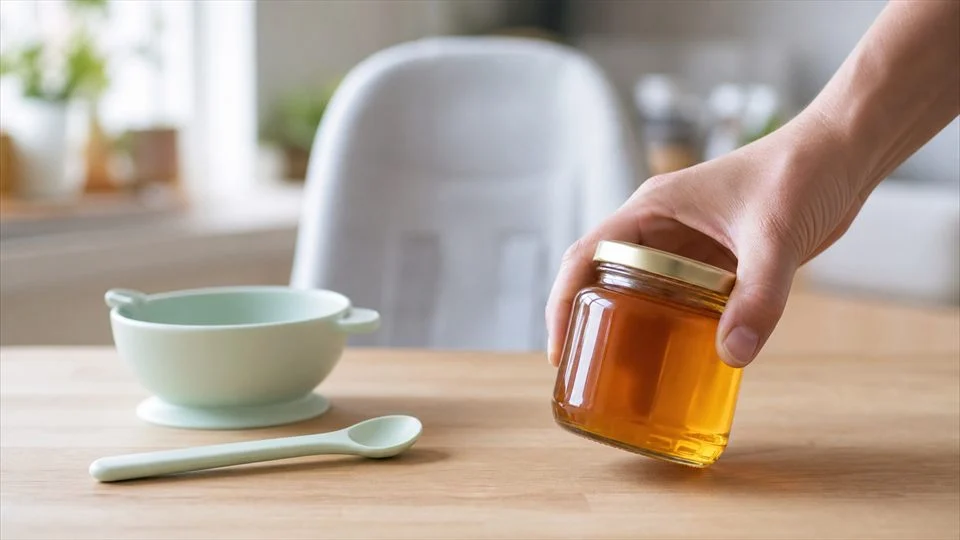
Why honey, and why only babies
Honey is the most frequently identified food source in cases of infant botulism; that is what the assessment by the Scientific Committee of AESAN records.3 It is not the only possible route, since the spores are present in the environment, but it is the only one a parent can eliminate completely with a single decision.
From one year old, the matured gut flora prevents the spores from germinating, and the risk by this route disappears. That is why the rule has such a sharp boundary: before twelve months, never; afterwards, without this problem.
What boiling does not fix
A frequent mistake: believing that heating honey makes it safe. Botulinum toxin is inactivated by heat, but the spores resist the temperatures of a domestic kitchen. Boiling honey does not remove the risk for an infant. The only effective measure is not to give it.1
Nor does it help to distinguish between raw and industrial honey: it makes no difference. Neither ordinary pasteurisation nor filtering guarantees the absence of spores.
The guidelines agree without exception
This is not an isolated recommendation or a manufacturer’s caution. The US CDC includes honey among the foods to avoid in the first year, including in water, formula or on a dummy.4 The British health service describes the same clinical picture.5 A 2026 review of global epidemiology and prevention policy insists that the message still does not fully reach the public.6
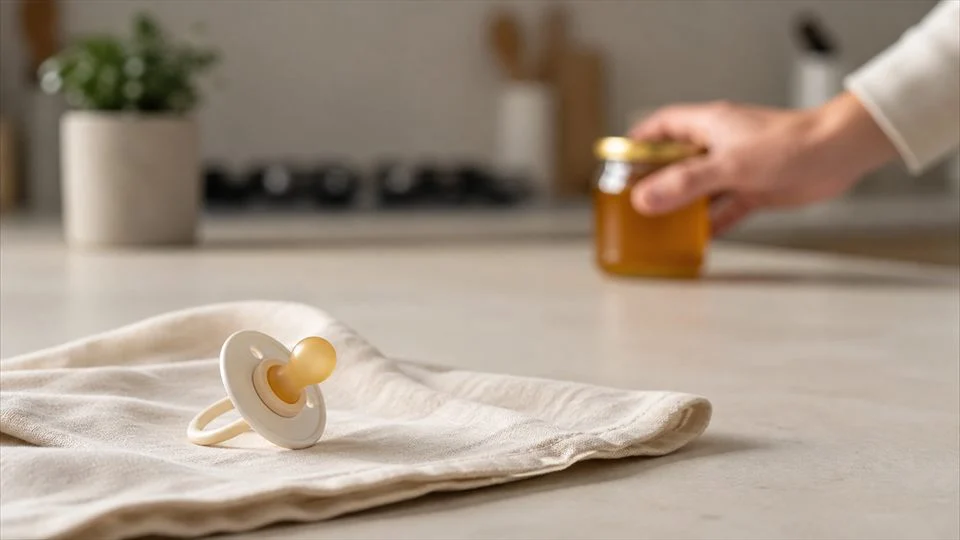
What to watch for if the baby has already tried honey
That a baby once took a small amount does not mean it will fall ill: most do not. But it is worth knowing what to observe over the following days, because the picture sets in slowly. The first sign is usually constipation (several days without stools), followed by changes in feeding: weaker sucking, longer feeds, unusual tiredness.7
Later the cry may become fainter, the eyelids may droop and there may be that overall loss of strength that gives the floppy baby its name. Faced with that combination, above all if there was exposure to honey, there is only one course of action: seek medical advice without delay. Infant botulism is treatable, and the outlook is better the sooner it is recognised.
The rule, in one line
No honey at all before twelve months. No exceptions for quantity, brand, type or method of preparation. It is the only categorical statement in our whole Diary, and it is one because the evidence is too. More context in allergies and precautions.
References
- Aricò, M. O., Caselli, D., Stefanizzi, P., Tafuri, S., & Aricò, M. (2026). Infant botulism and honey exposure: global epidemiology, prevention policies and communication strategies. Acta Paediatrica, 115(7), 1429-1433. https://pubmed.ncbi.nlm.nih.gov/41964486/
- Harris, R. A., & Dabritz, H. A. (2024). Infant botulism: in search of Clostridium botulinum spores. Current Microbiology, 81(10), 306. https://pubmed.ncbi.nlm.nih.gov/39138824/
- Cox, N., & Hinkle, R. (2002). Infant botulism. American Family Physician, 65(7), 1388-1392. https://pubmed.ncbi.nlm.nih.gov/11996423/
- Comité Científico de la AESAN (2011). Informe del Comité Científico de la AESAN sobre el botulismo infantil. AESAN [PDF]. https://www.aesan.gob.es/AECOSAN/docs/documentos/seguridad_alimentaria/evaluacion_riesgos/informes_comite/BOTULISMO_INFANTIL.pdf
- Centers for Disease Control and Prevention (s. f.). Foods and drinks to avoid or limit. CDC. Consultado el 19 de julio de 2026. https://www.cdc.gov/infant-toddler-nutrition/foods-and-drinks/foods-and-drinks-to-avoid-or-limit.html
- National Health Service (s. f.). Botulism. NHS. Consultado el 19 de julio de 2026. https://www.nhs.uk/conditions/botulism/
- Brook, I. (2007). Infant botulism. Journal of Perinatology, 27(3), 175-180. https://pubmed.ncbi.nlm.nih.gov/17314986/