Honey is one of the most faked foods in the world. Not with poison, but with cheap syrup, opaque blends and blurred origins. Understanding how it is adulterated is the best defence a buyer has, better even than trusting a brand.
What adulterating honey means
There are two large families of fraud. The direct kind: adding cheap sugar syrups (from rice, maize, beet) to a real honey, or simply selling them as honey. And the indirect kind: lying about the botanical or geographical origin, blending honeys of different provenance without declaring it, or feeding the bees syrup during the flow.
The first is a chemical swindle; the second, a label swindle. Reviews on authenticity treat both as the same problem: a chain in which it is easy to make money by blurring traceability.1
How a laboratory detects it
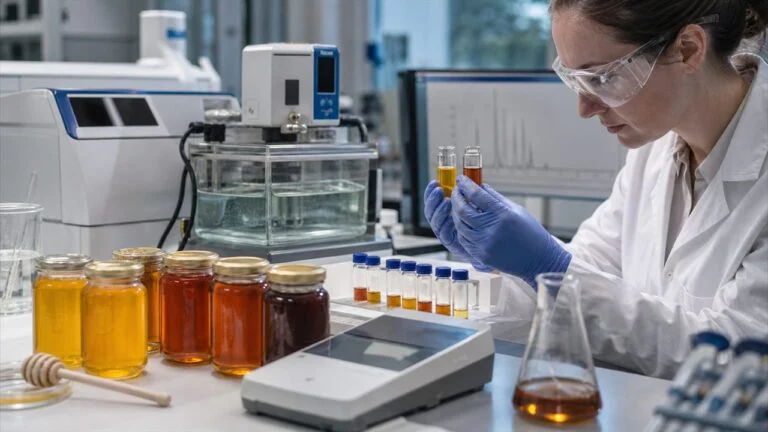
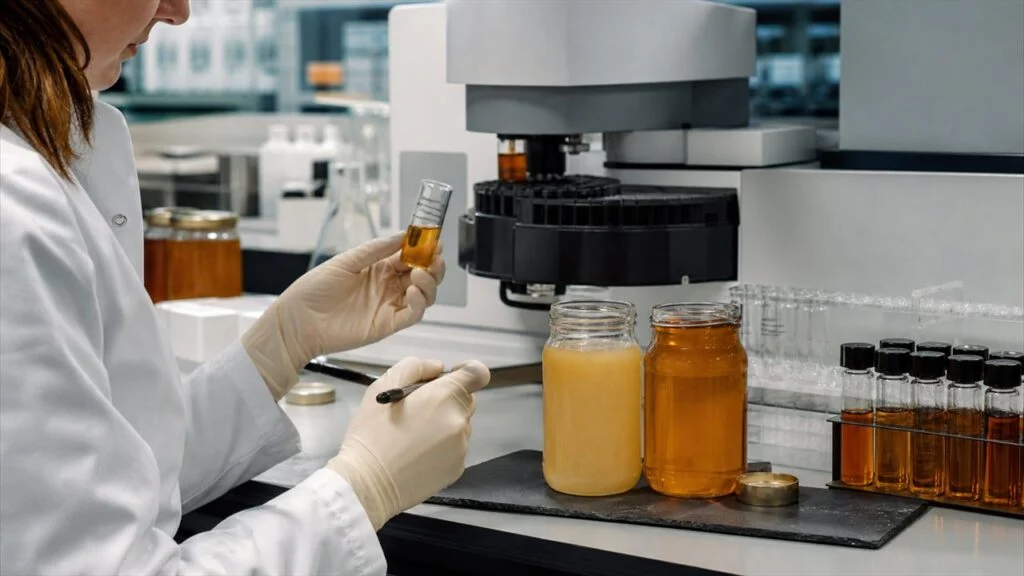
Analytical science has been chasing this for decades, and the fraud has been evolving to dodge it. Several techniques are combined today because none is enough on its own:
Stable isotopes (IRMS). Distinguishes sugar from cane and maize, C4 plants, from that of the flowers the bees visit. It is the classic test against added syrup.
Nuclear magnetic resonance (NMR). Takes a complete chemical fingerprint of the honey and compares it with reference databases. Platforms integrating NMR and IRMS have been proposed precisely to close the gaps each method leaves.2
NIR spectroscopy. Faster and cheaper, it is being investigated for quantifying and verifying authenticity non destructively.3
The law has got serious about origin
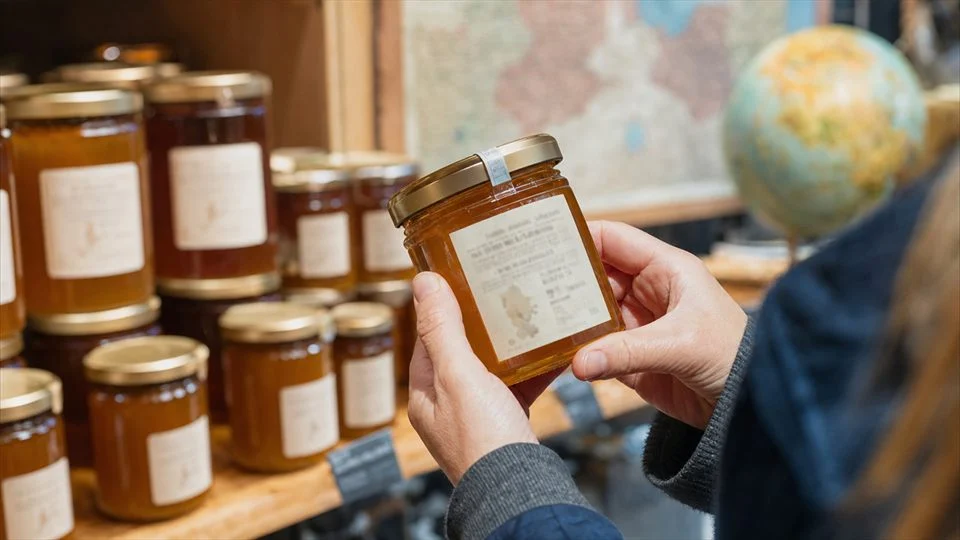
For years a jar could declare a blend of EU and non EU honeys, a formula that says nothing. Directive (EU) 2024/1438, which amends the old honey Directive of 2001,7 requires the label to state the countries of origin where the honey was harvested, and in what order.4 It is the greatest advance in traceability for the consumer in two decades.
The international reference standard remains the Codex Alimentarius, which defines what may be called honey and what may not.5
The case of Manuka honey
No honey concentrates as much fraud as Manuka: its high price and its fame make it a perfect target for cutting with syrups or for misleading labelling of the UMF/MGO grade. A review has been devoted specifically and exclusively to its methods of analysis and authentication, a sign of how far a single product can sustain an entire line of analytical research.6
The lesson for every other honey is useful: the dearer and more prestigious a denomination is, the greater the incentive to imitate it, and the more a bargain deserves suspicion. Fraud follows value.
What you can look at yourself, without a laboratory
It does not replace an IRMS, but it rules out a good deal:
A specific origin. A country, a region, better still a floral source. Vagueness is the first warning sign.
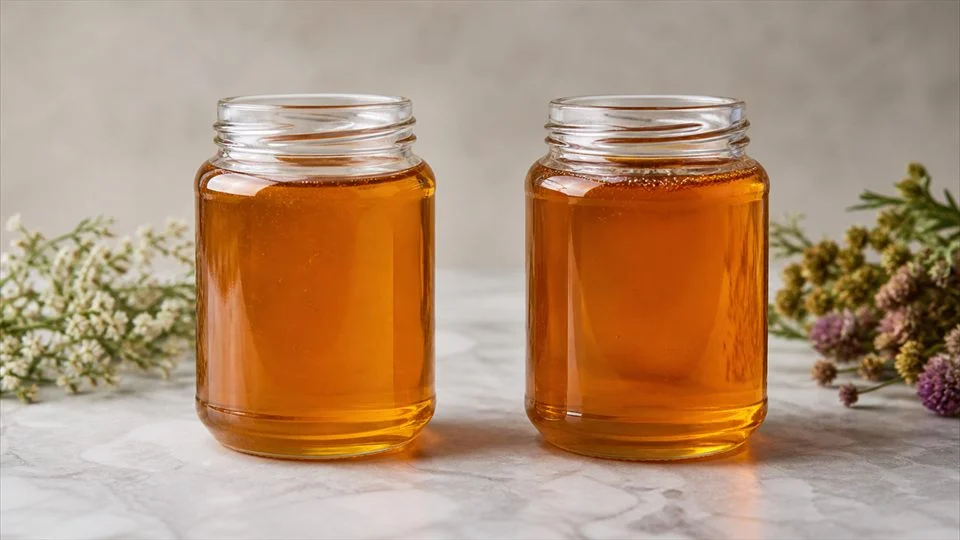
That it crystallises. A raw honey crystallises sooner or later. One that stays liquid and clear forever has been heavily heated or pressure filtered, or is not what it says.
A price that makes sense. Producing real honey costs money. A monofloral honey at the price of sugar is suspect by arithmetic.
HMF, if it is given. A low value indicates little heat abuse; we explain it in its own article.
No home test is conclusive (the glass of water and the paper have no basis), but the sum of a specific label, crystallisation and a coherent price leaves out most of the crude frauds.
References
- Zhang, X. H., Gu, H. W., Liu, R. J., Qing, X. D., & Nie, J. F. (2023). A comprehensive review of the current trends and recent advancements on the authenticity of honey. Food Chemistry: X, 19, 100850. https://pubmed.ncbi.nlm.nih.gov/37780275/
- Biswas, A., Naresh, K. S., Jaygadkar, S. S., & Chaudhari, S. R. (2023). Enabling honey quality and authenticity with NMR and LC-IRMS based platform. Food Chemistry, 416, 135825. https://pubmed.ncbi.nlm.nih.gov/36924528/
- Biswas, A., & Chaudhari, S. R. (2024). Exploring the role of NIR spectroscopy in quantifying and verifying honey authenticity: a review. Food Chemistry, 445, 138712. https://pubmed.ncbi.nlm.nih.gov/38364494/
- Parlamento Europeo y Consejo de la Unión Europea (2024). Directiva (UE) 2024/1438, de 14 de mayo de 2024, por la que se modifican las Directivas 2001/110/CE relativa a la miel y otras. Diario Oficial de la Unión Europea, serie L, 24.5.2024. https://eur-lex.europa.eu/legal-content/ES/TXT/?uri=CELEX%3A32024L1438
- FAO & OMS (2022). Standard for Honey (CXS 12-1981, rev. 2022). Codex Alimentarius Commission, Roma. https://www.fao.org/fao-who-codexalimentarius/codex-texts/list-standards/en/
- Hegazi, N. M., Elghani, G. E. A., & Farag, M. A. (2022). The super-food Manuka honey, a comprehensive review of its analysis and authenticity approaches. Journal of Food Science and Technology, 59(7), 2527-2534. https://pubmed.ncbi.nlm.nih.gov/35734106/
- Consejo de la Unión Europea (2001). Directiva 2001/110/CE del Consejo, de 20 de diciembre de 2001, relativa a la miel. Diario Oficial de las Comunidades Europeas, L 10, 47–52. https://eur-lex.europa.eu/legal-content/ES/TXT/?uri=CELEX%3A32001L0110