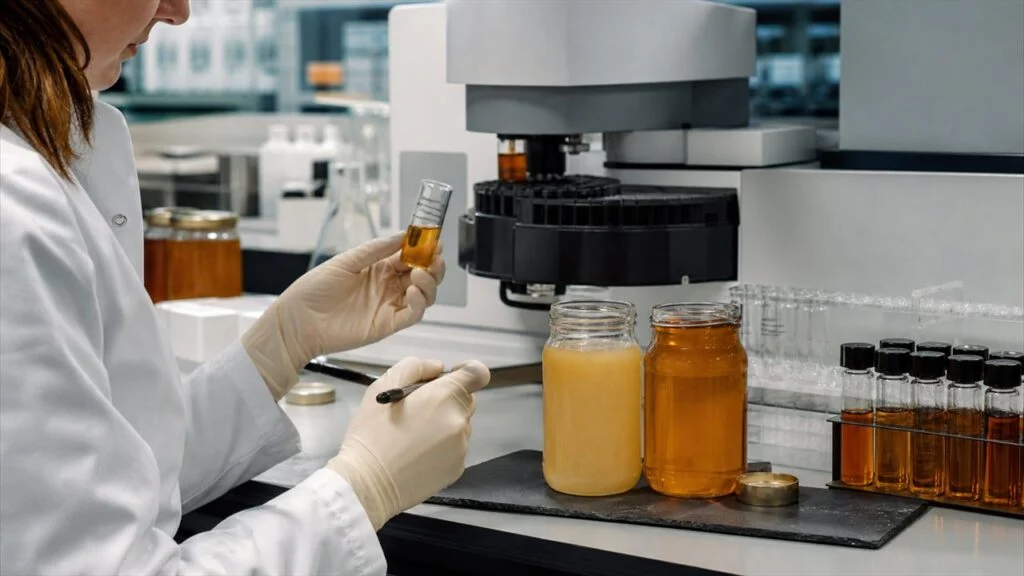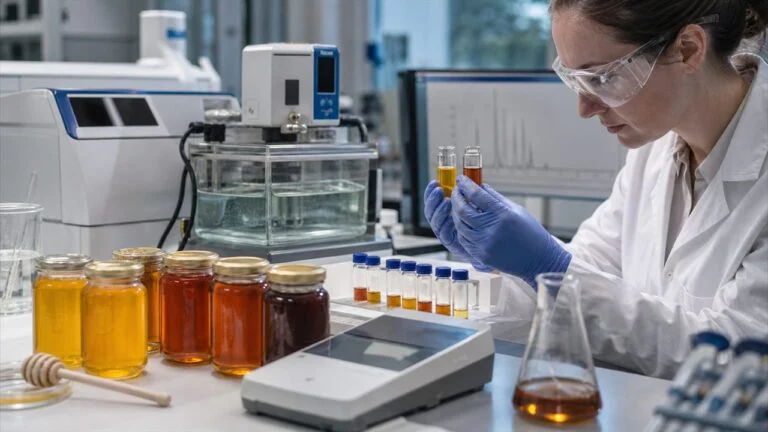
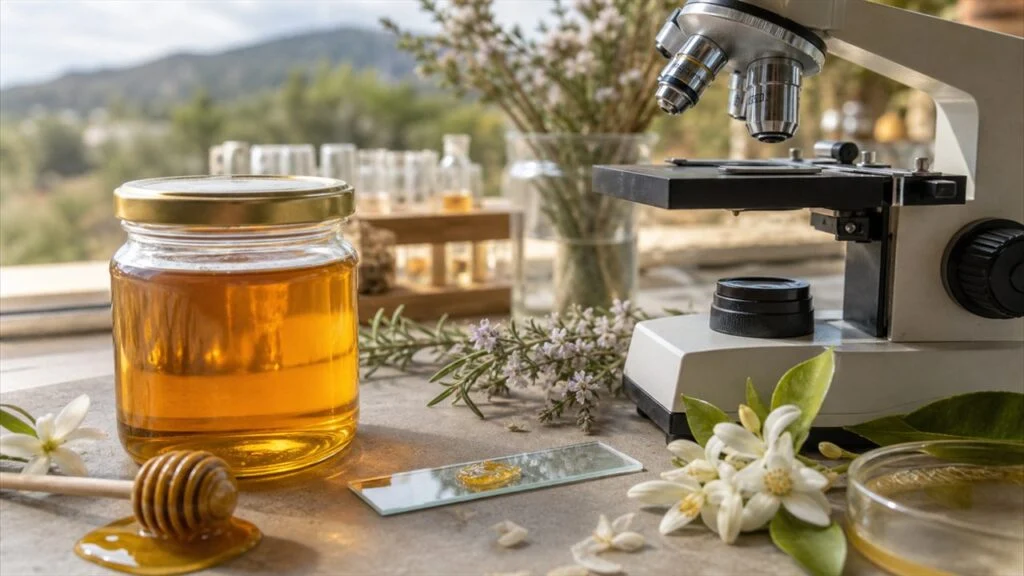
When we say a honey is rosemary or orange blossom, we are not guessing it from the taste. There is a discipline that counts, grain by grain, which flowers each jar came from. It is called melissopalynology, and it is the oldest identity test honey has.
Every honey carries its own papers
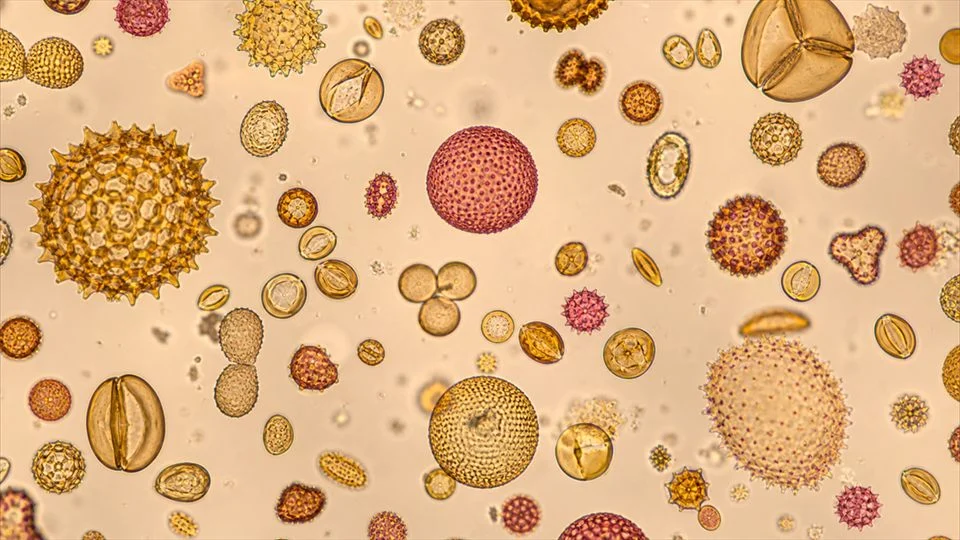
When a bee forages, it unwittingly drags along pollen grains from the same flower. Those grains end up in the honey. By looking at a sample under the microscope and counting and identifying the pollens present, the pollen spectrum is reconstructed: which flowers the bees visited and in what proportion.5
For a honey to be called monofloral, the pollen of that species must dominate the spectrum according to established thresholds.6 It is not a marketing label: it is a count.
What it is really for
It serves to authenticate. It has been used to tell monofloral from multifloral honeys by combining pollen analysis with antioxidant properties,1 and to assess honey quality alongside chemical analysis.2 Also to verify the origin of highly prized honeys, where a false label is worth money.3
And it serves something less obvious: reading the landscape. The pollen of a honey draws a map of what was in flower around the apiary that season. It is, incidentally, a record of biodiversity.
Its limits, stated plainly
Melissopalynology is not infallible. Some much visited flowers contribute little pollen to the honey (orange blossom, to name one) and end up under represented; others contribute a great deal even while being secondary. Aggressive filtering removes pollen and erases the evidence. That is why serious analysis combines the count with physico chemical parameters, and why modern authenticity platforms do not rest on a single technique.
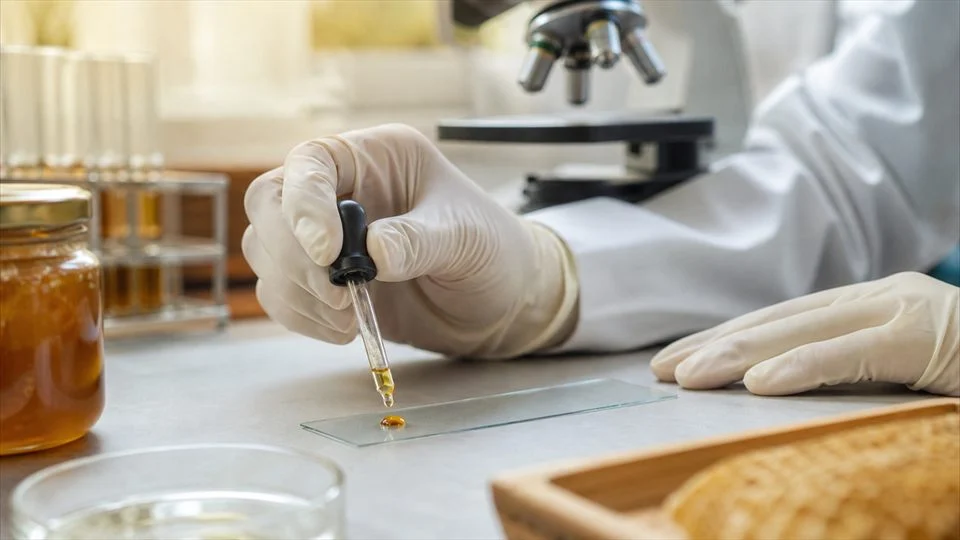
Pollen also tells where the bee has been
There is a less commercial and more fascinating use of this discipline: reconstructing the foraging behaviour of bees. By analysing the pollen in honey it has been studied which flowers they prefer in a given territory and how those preferences change with the season, something documented, for example, in tropical southern India.4
For a beekeeper this is no anecdote: knowing which flowerings really sustain their hives informs where to place them and when. Honey, read under the microscope, is at once a product and a field diary of the season.
What this means for your jar
That a honey retains pollen is a good sign: it indicates it has not been ultrafiltered to erase its trace. That its botanical origin is declared with the name of a floral source, and not a generic flower honey, indicates that somebody took the trouble to know where it comes from.
It is the same logic that governs the new European rules on origin7 and the fight against fraud: the more specific the label’s claim, the easier it is to check whether it is true. A honey that can be traced is a honey that does not fear being analysed.
References
- Hailu, D., & Belay, A. (2020). Melissopalynology and antioxidant properties used to differentiate Schefflera abyssinica and polyfloral honey. PLoS ONE, 15(10), e0240868. https://pubmed.ncbi.nlm.nih.gov/33112916/
- Shakoori, Z., Mehrabian, A., Minai, D., Salmanpour, F., & Khajoei Nasab, F. (2023). Assessing the quality of bee honey on the basis of melissopalynology as well as chemical analysis. PLoS ONE, 18(8), e0289702. https://pubmed.ncbi.nlm.nih.gov/37552683/
- Islam, M. K., Lawag, I. L., Green, K. J., Sostaric, T., Hammer, K. A., & Lim, L. Y. (2022). An investigation of the suitability of melissopalynology to authenticate Jarrah honey. Current Research in Food Science, 5, 506-514. https://pubmed.ncbi.nlm.nih.gov/35281336/
- Ponnuchamy, R., Bonhomme, V., Prasad, S., Das, L., Patel, P., & Gaucherel, C. (2014). Honey pollen: using melissopalynology to understand foraging preferences of bees in tropical South India. PLoS ONE, 9(7), e101618. https://pubmed.ncbi.nlm.nih.gov/25004103/
- Von Der Ohe, W., Persano Oddo, L., Piana, M. L., Morlot, M. & Martin, P. (2004). Harmonized methods of melissopalynology. Apidologie, 35(S1), S18–S25. https://www.academia.edu/121979867/Harmonized_methods_of_melissopalynology
- FAO & OMS (2022). Standard for Honey (CXS 12-1981, rev. 2022). Codex Alimentarius Commission, Roma. https://www.fao.org/fao-who-codexalimentarius/codex-texts/list-standards/en/
- Parlamento Europeo y Consejo de la Unión Europea (2024). Directiva (UE) 2024/1438, de 14 de mayo de 2024, por la que se modifican las Directivas 2001/110/CE relativa a la miel y otras. Diario Oficial de la Unión Europea, serie L, 24.5.2024. https://eur-lex.europa.eu/legal-content/ES/TXT/?uri=CELEX%3A32024L1438