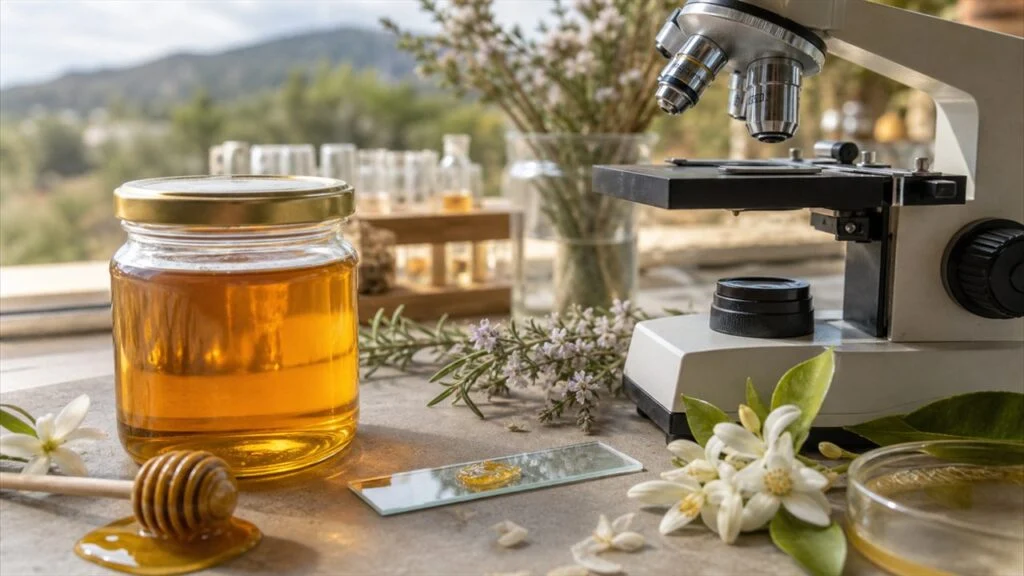
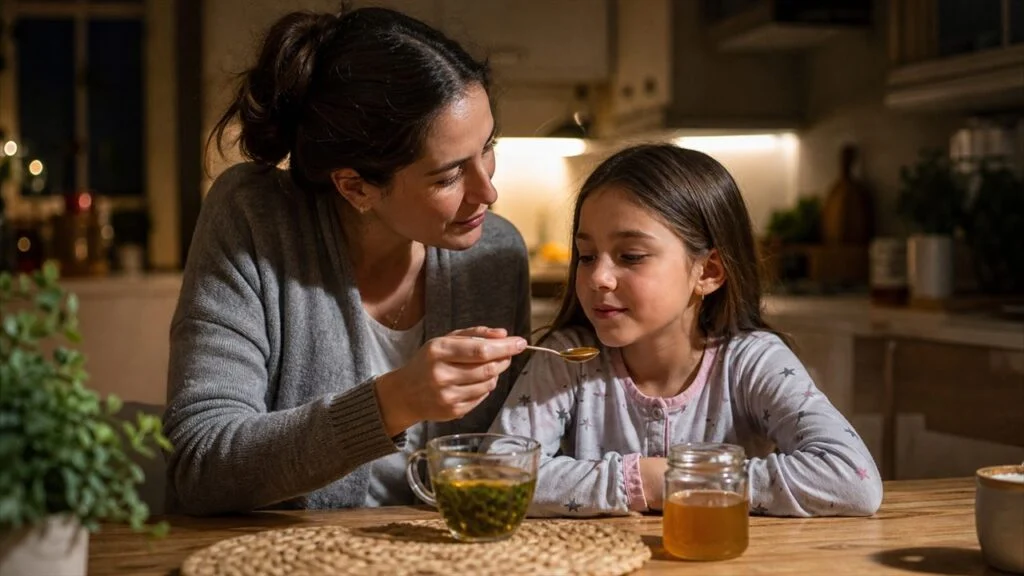
It is rare for a grandmother’s remedy to survive a Cochrane review. Honey for a night time cough has: there is reasonable evidence that it helps. With one condition that admits no forgetting: never before the first year of life.
What the best evidence says
The Cochrane review on honey for acute cough in children concludes that it probably relieves more than giving nothing and more than placebo, and that it could be comparable to some cough suppressants, with the advantage of a favourable safety profile from one year old.1 It is not a stray trial: it is a synthesis of several, with its limitations stated.
A later systematic review, from 2023, reaches a consistent conclusion for acute cough in childhood.2 And a meta-analysis on upper respiratory tract infections found an improvement in symptoms, while warning of the heterogeneity of the studies.3
Why it might work
There is no single confirmed mechanism, only reasonable hypotheses. Its viscosity could form a layer that soothes the irritated lining of the throat. Its sweetness stimulates salivation and swallowing, which reduce the cough reflex. And its phenolic composition contributes some antioxidant activity. None of these explanations is settled, and it is honest to say so.
How to use it sensibly
From 12 months, never before. This sentence is non negotiable and points to the same reason as infant botulism, see our piece on honey and babies.567
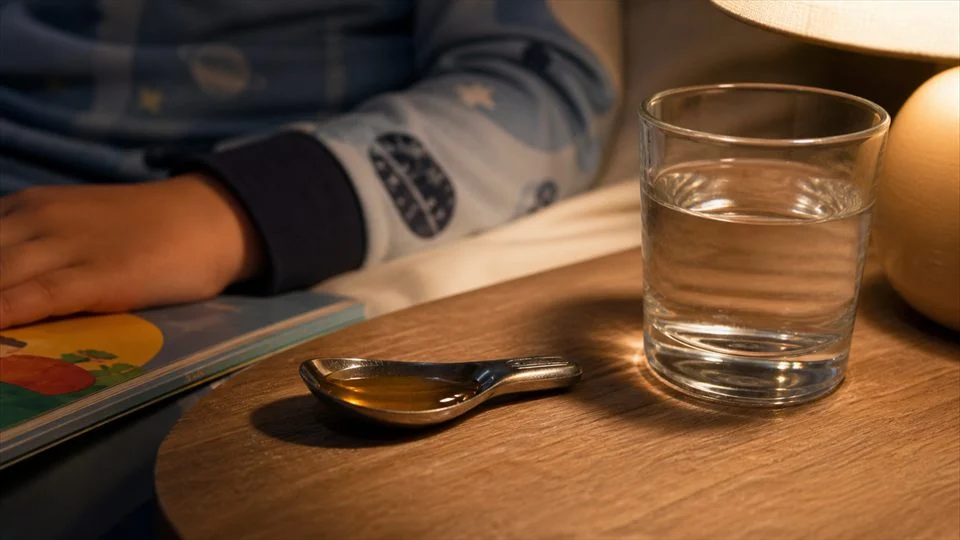
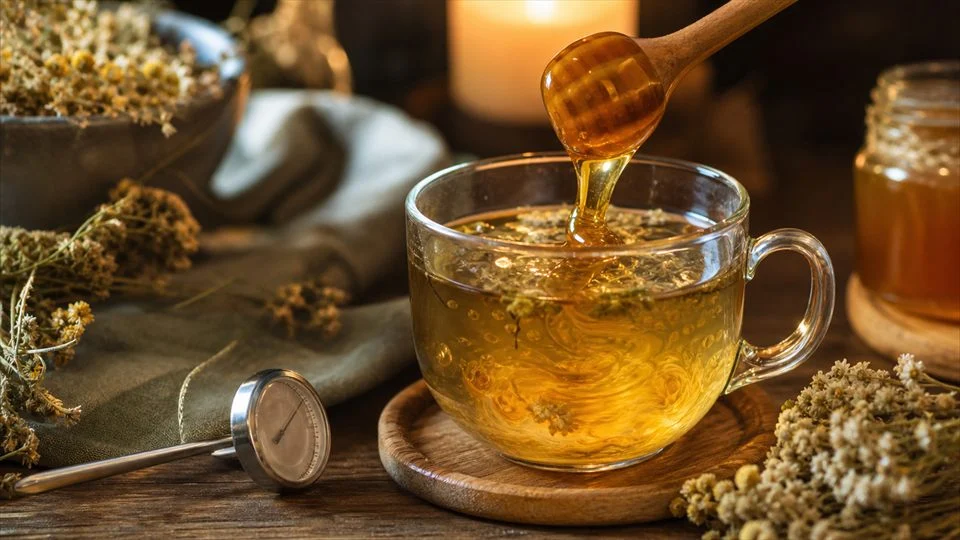
One or two teaspoons, on its own or in warm water, before sleep.
Warm, not hot. Above 40 °C it is no more effective and its profile does degrade.
It does not replace a consultation. A cough with high fever, difficulty breathing or one that lasts longer than it should is a reason to see a doctor, not to reach for honey.
And a dental note: it is sugar. After the night time honey, brush. The benefit for the cough does not cancel the effect on enamel.
Where it fits within paediatric practice
Honey does not compete with the treatment of a disease: it competes with doing nothing and with syrups whose effectiveness in children is not well demonstrated either. On that ground, a systematic review and practical algorithm from the Italian society of paediatric allergy places acute cough in its context and helps distinguish the kind managed at home from the kind that needs a doctor.4
The sensible reading is this: for a night time cough with no warning signs in a child over one year old, a spoonful of honey before sleep is a reasonable, low risk option. Not because it is a medicine, but because in that specific scenario the evidence backs it better than it backs most over the counter alternatives.
Which honey to choose
For this use any raw, well kept honey will do; the floral source changes the flavour, not the effectiveness. Those with a balsamic profile (eucalyptus, thyme) are pleasant warm, but that is preference, not pharmacology. What does matter is that it has not been through heat: a heavily processed honey has lost along the way much of what made it interesting, as we explain in our piece on HMF.
References
- Oduwole, O., Udoh, E. E., Oyo-Ita, A., & Meremikwu, M. M. (2018). Honey for acute cough in children. Cochrane Database of Systematic Reviews, 4(4), CD007094. https://pubmed.ncbi.nlm.nih.gov/29633783/
- Kuitunen, I., & Renko, M. (2023). Honey for acute cough in children: a systematic review. European Journal of Pediatrics, 182(9), 3949-3956. https://pubmed.ncbi.nlm.nih.gov/37355498/
- Abuelgasim, H., Albury, C., & Lee, J. (2021). Effectiveness of honey for symptomatic relief in upper respiratory tract infections: a systematic review and meta-analysis. BMJ Evidence-Based Medicine, 26(2), 57-64. https://pubmed.ncbi.nlm.nih.gov/32817011/
- Marseglia, G. L., Manti, S., Chiappini, E., Brambilla, I., Caffarelli, C., & Calvani, M. (2021). Acute cough in children and adolescents: a systematic review and a practical algorithm by the Italian Society of Pediatric Allergy and Immunology. Allergologia et Immunopathologia, 49(2), 155-169. https://pubmed.ncbi.nlm.nih.gov/33641306/
- Centers for Disease Control and Prevention (s. f.). Foods and drinks to avoid or limit. CDC. Consultado el 19 de julio de 2026. https://www.cdc.gov/infant-toddler-nutrition/foods-and-drinks/foods-and-drinks-to-avoid-or-limit.html
- Comité Científico de la AESAN (2011). Informe del Comité Científico de la AESAN sobre el botulismo infantil. AESAN [PDF]. https://www.aesan.gob.es/AECOSAN/docs/documentos/seguridad_alimentaria/evaluacion_riesgos/informes_comite/BOTULISMO_INFANTIL.pdf
- National Health Service (s. f.). Botulism. NHS. Consultado el 19 de julio de 2026. https://www.nhs.uk/conditions/botulism/