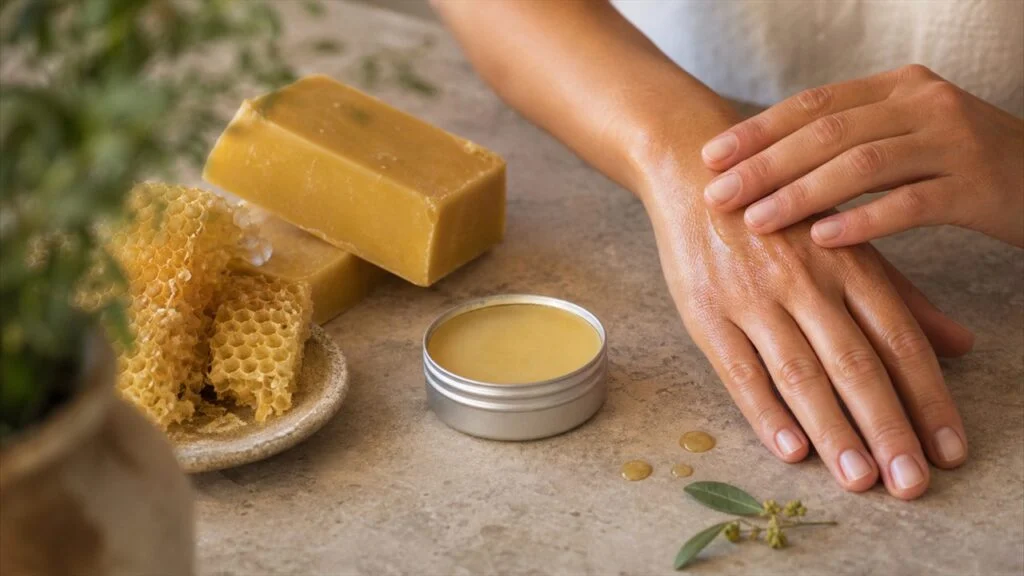
Beeswax has been in cosmetics since before the word cosmetics existed. It does not hydrate, does not nourish and does not repair: it does something else, and it does it better than almost any synthetic alternative. That something else is worth understanding.
A material, not an active ingredient
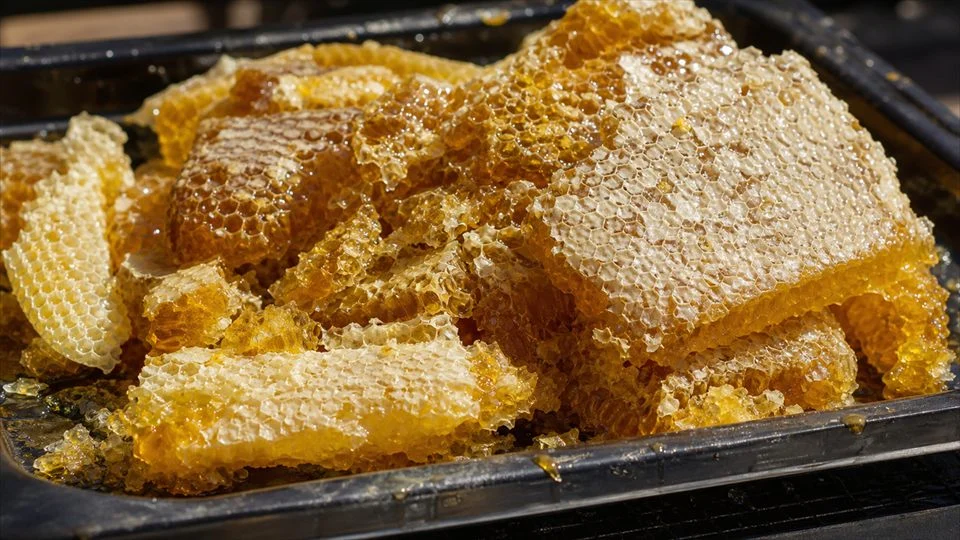
Young bees secrete it from glands on the abdomen to build the comb. Chemically it is a complex mixture of long chain esters, free fatty acids and hydrocarbons. That structure explains its behaviour: it melts at around 62-65 °C, is solid and pliable at room temperature and is completely hydrophobic.
It is precisely that hydrophobicity that has made it a reference material for coatings, to the point that it is being investigated for superhydrophobic films to preserve fruit.1 On skin it does the same thing it does on an apple.
What it actually does on the skin
It forms an occlusive film: it does not supply water, it retains the water already there by reducing transepidermal loss. That is why it works on lips, cracked hands and areas exposed to cold, and why it makes no sense to expect from it what you expect from a humectant.
The review specific to its use in skin care records that barrier function alongside its emollient properties and its structural role in formulations.2 The broader review of bee products in dermatology places it in the same group as honey and propolis: ingredients with a long clinical history and uneven evidence.3
What it does not do
It does not penetrate. It does not regenerate tissue. It is not an anti-ageing active. A formula that attributes active ingredient effects to wax is selling the excipient as though it were the medicine.
Why a short formula is usually better
Wax solves occlusion and texture at the same time, which allows formulation with very few ingredients: a vegetable oil, wax and little else. Every ingredient added is one more chance of sensitisation, and on reactive skin that weighs more than any promise on the label.
An honest note about our own product: a soap with wax and honey cleans. Containing hive ingredients does not make it a dermatological treatment, and we do not present it as one.
Wax and allergy
Pure wax is among the hive materials with the least sensitising power. The problem is rarely the wax: it is the propolis residues that come with it when filtering is superficial, and propolis is a well characterised contact sensitiser.4 Its compounds share an origin with poplar buds and balsam of Peru, which explains many cross reactions.5 Someone reacting to a beeswax balm is usually reacting to that, and it is worth knowing before writing off a whole group of products.
Wax, propolis and children’s skin
This deserves a note because it affects a specific group. Sensitisation to propolis, the usual contaminant of poorly filtered wax, has also been described in children: in a series of 1,255 children given patch tests it appeared associated with sensitivity to balsam of Peru.6 And propolis itself is among the best documented contact sensitisers.7
The practical conclusion is not to avoid wax, but to demand serious filtering and to be wary of very resinous wax balms where there is a history of allergy. Clean wax is one of the most forgiving materials there is for delicate skin.
How to recognise well treated wax
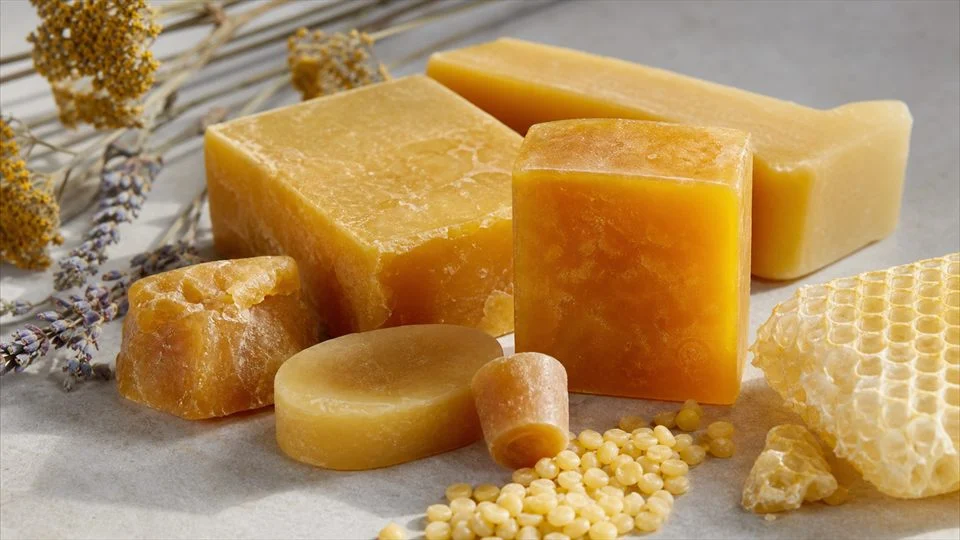
Smell. It should smell of honey and comb, not of nothing. An odourless wax has been bleached or deodorised.
Colour. From pale yellow to brown depending on bloom and age. Pure white is chemistry, not origin.
Feel. It softens with the warmth of the hand; if it stays hard and brittle, it is probably mixed with paraffin.
References
- Hosseini, S. F., Mousavi, Z., & McClements, D. J. (2023). Beeswax: a review on the recent progress in the development of superhydrophobic films/coatings and their applications in fruits preservation. Food Chemistry, 424, 136404. https://pubmed.ncbi.nlm.nih.gov/37257280/
- Nong, Y., Maloh, J., Natarelli, N., Gunt, H. B., Tristani, E., & Sivamani, R. K. (2023). A review of the use of beeswax in skincare. Journal of Cosmetic Dermatology, 22(8), 2166-2173. https://pubmed.ncbi.nlm.nih.gov/36999457/
- Kurek-Górecka, A., Górecki, M., Rzepecka-Stojko, A., Balwierz, R., & Stojko, J. (2020). Bee products in dermatology and skin care. Molecules, 25(3), 556. https://pubmed.ncbi.nlm.nih.gov/32012913/
- Zullkiflee, N., Taha, H., & Usman, A. (2022). Propolis: its role and efficacy in human health and diseases. Molecules, 27(18), 6120. https://pubmed.ncbi.nlm.nih.gov/36144852/
- Hausen, B. M., Evers, P., Stüwe, H. T., König, W. A., & Wollenweber, E. (1992). Propolis allergy (IV). Studies with further sensitizers from propolis and constituents common to propolis, poplar buds and balsam of Peru. Contact Dermatitis, 26(1), 34-44. https://pubmed.ncbi.nlm.nih.gov/1600736/
- Giusti, F., Miglietta, R., Pepe, P., & Seidenari, S. (2004). Sensitization to propolis in 1255 children undergoing patch testing. Contact Dermatitis, 51(5-6), 255-258. https://pubmed.ncbi.nlm.nih.gov/15606649/
- British Society for Cutaneous Allergy (s. f.). Propolis [hoja informativa para pacientes]. BSCA. Consultado el 19 de julio de 2026. https://cutaneousallergy.org/pils/propolis/