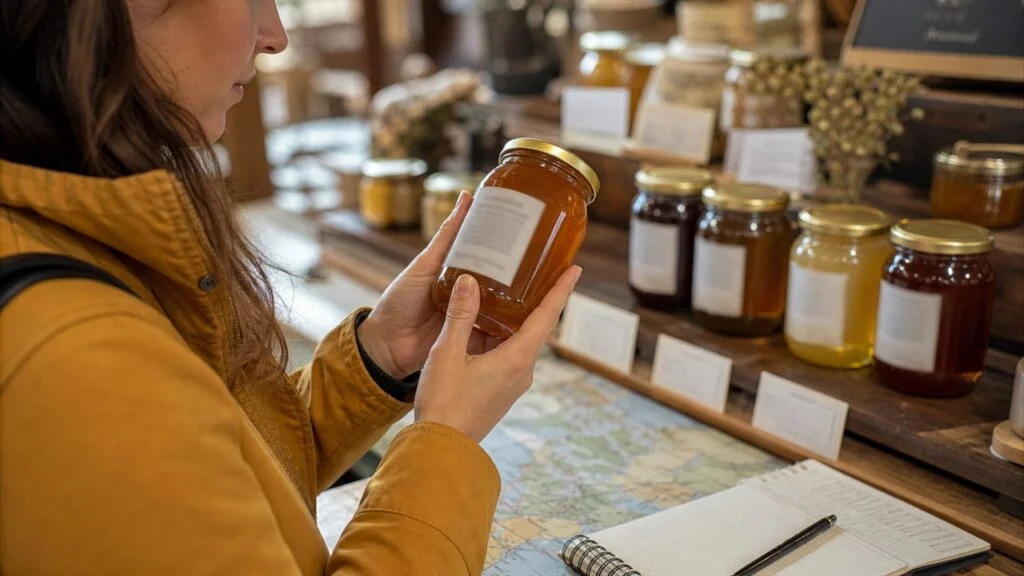
The label on a jar of honey is a legal document dressed up as design. Learning to read it changes completely what you buy, and explains why two apparently identical jars cost three euros or fourteen.
What the law obliges it to say
Directive 2001/110/EC defines what may be called honey in the European Union, which denominations exist, blossom honey, honeydew honey, comb honey, drained, extracted, pressed, and which composition criteria each must meet.1
Its annexes set the concrete numbers: maximum moisture, sugar content, electrical conductivity, free acidity, minimum diastase activity and maximum HMF.2 The Codex Alimentarius standard establishes equivalent criteria internationally.3
None of that appears on the front of the jar. It appears, when it appears at all, in seven point type on the back.
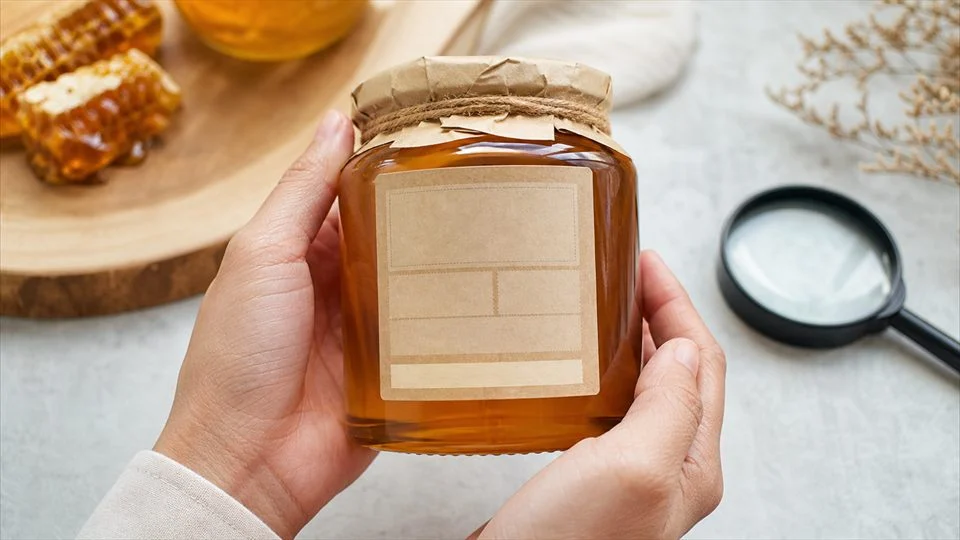
The four sentences that matter
1. The origin
For years the formula blend of EU honeys / blend of non-EU honeys made it possible not to declare a country. If you read it, you already know the essential thing: there is no origin traceability in that jar. A single declared country, and better still a specific district, is the strongest signal a label can offer.
2. The floral denomination
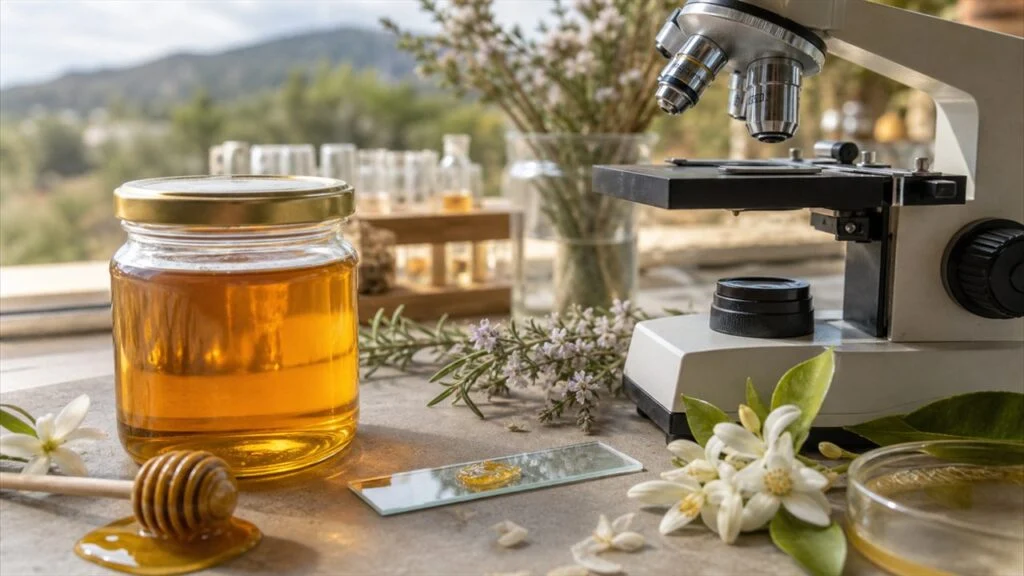
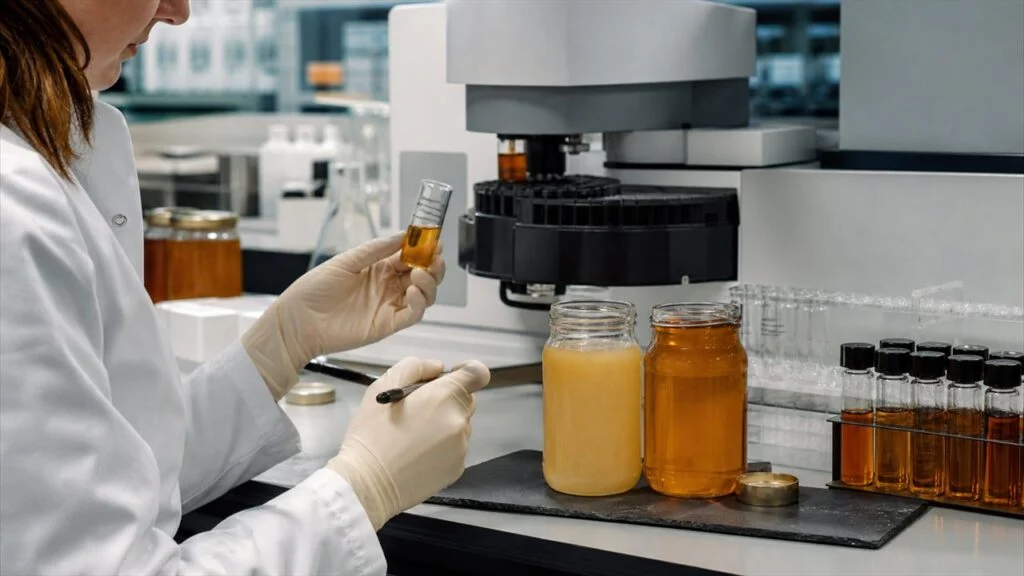
Rosemary honey implies a predominance of that species. Verification is done by pollen analysis, the reference method for botanical origin.4 If the honey has been ultrafiltered, that pollen is gone and the claim stops being checkable.5
3. The batch number
It is what allows a jar to be traced back to a specific harvest and its report requested. With no visible batch there is no possible complaint and no analysis you can demand.
4. Packed by versus Produced by
They are not the same, and the difference is the entire business. Packed by can simply mean that somebody bought drums on an international market and shared them out into attractive jars.
Warning signs
- Never crystallises presented as a virtue. It usually means pasteurised and microfiltered.
- No harvest date at all. Honey does not expire, but its age matters: HMF rises over time.
- Vague denominations: pure bee honey, natural honey, which mean nothing in law.
- An impossible price. Below a certain threshold the arithmetic of beekeeping simply does not work.
Why the price varies so much
A single origin monofloral honey, cold extracted, analysed batch by batch and with sufficient stores left to the colony cannot cost the same as an industrial blend. The difference is not in the jar: it is in how many decisions were taken in favour of the bee and against yield.
And those decisions have a far wider context: the IPBES global assessment puts the agricultural production that depends on pollinators at between 235 and 577 billion dollars a year.6 What you pay for a traceable jar indirectly finances that service.
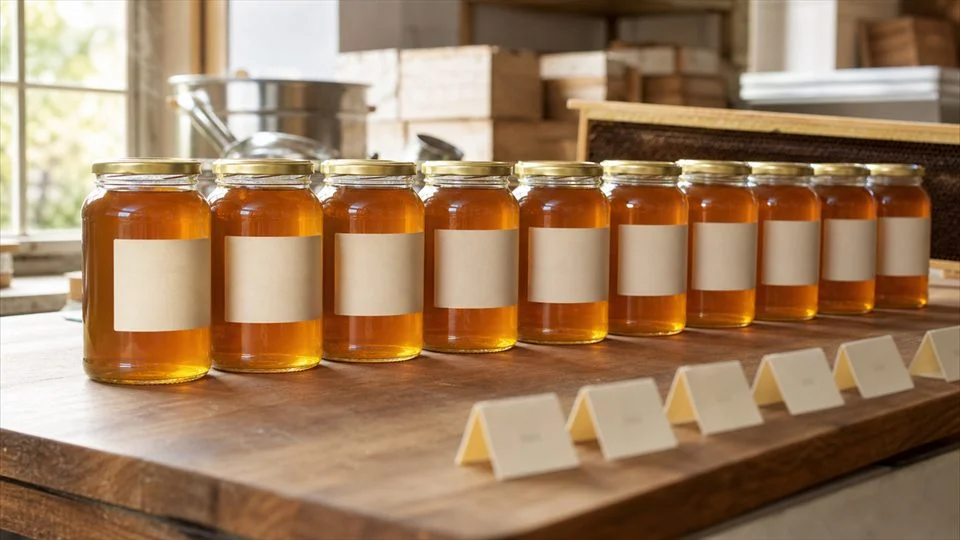
How we read somebody else’s label
We look, in this order, for: a single declared country; a specific floral denomination; a visible batch; the absence of the word pasteurised; and a harvest or best before date that lets us work out the age.
If all five hold, the jar deserves a chance. If the origin fails, there is nothing else to look at.
References
- Consejo de la Unión Europea (2001). Directiva 2001/110/CE del Consejo, de 20 de diciembre de 2001, relativa a la miel. Diario Oficial de las Comunidades Europeas, L 10, 47–52. https://eur-lex.europa.eu/legal-content/ES/TXT/?uri=CELEX%3A32001L0110
- Consejo de la Unión Europea (2001). Directiva 2001/110/CE, Anexo II: criterios de composición de la miel. Legislation.gov.uk (EU retained law). https://www.legislation.gov.uk/eudr/2001/110/annex/II
- FAO & OMS (2022). Standard for Honey (CXS 12-1981, rev. 2022). Codex Alimentarius Commission, Roma. https://www.fao.org/fao-who-codexalimentarius/codex-texts/list-standards/en/
- Von Der Ohe, W., Persano Oddo, L., Piana, M. L., Morlot, M. & Martin, P. (2004). Harmonized methods of melissopalynology. Apidologie, 35(S1), S18–S25. https://www.academia.edu/121979867/Harmonized_methods_of_melissopalynology
- Tafere, D. A., et al. (2020). Melissopalynology and antioxidant properties used to differentiate Schefflera abyssinica and polyfloral honey. PLOS ONE, 15(10), e0240868. https://journals.plos.org/plosone/article?id=10.1371%2Fjournal.pone.0240868
- IPBES (2016). The assessment report on pollinators, pollination and food production. Intergovernmental Science-Policy Platform on Biodiversity and Ecosystem Services, Bonn. https://www.ipbes.net/assessment-reports/pollinators
- Bogdanov, S., Martin, P. & Lüllmann, C. (International Honey Commission) (2009). Harmonised methods of the International Honey Commission. IHC Platform, Swiss Bee Research Centre. https://www.ihc-platform.net/ihcmethods2009.pdf
- Eurofins Scientific (2023). HMF in honey — why do we test for it?. Eurofins Food Testing, technical note. https://www.eurofins.in/food-testing/blog/hmf-in-honey/