
Honey comes into the kitchen through the wrong door: as a sugar substitute. It is a different ingredient, with rules of its own, and almost all of them come down to a single variable: temperature.
The 40 degree threshold
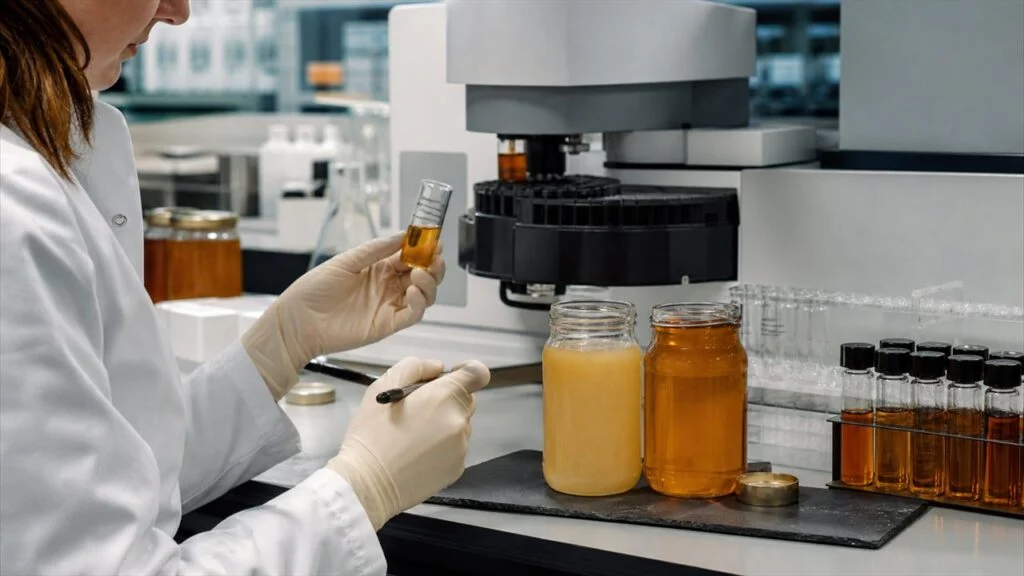
Above 40 °C honey begins to lose what made it interesting. The enzymes the bee contributes, measured as diastase activity, degrade, and hydroxymethylfurfural rises. The reference methods for both parameters are described by the International Honey Commission.1
European rules cap HMF at 40 mg/kg precisely because it works as a marker of heat and of age.2 Cooking with honey is no crime, but it is worth knowing what you are sacrificing and when it is worth it.
The practical rule
If honey is the protagonist of the dish, do not heat it. If it is a structural ingredient (moisture, colour, texture) use a simple honey and heat it as much as the recipe needs.
Three uses where honey wins
1. Cold, always
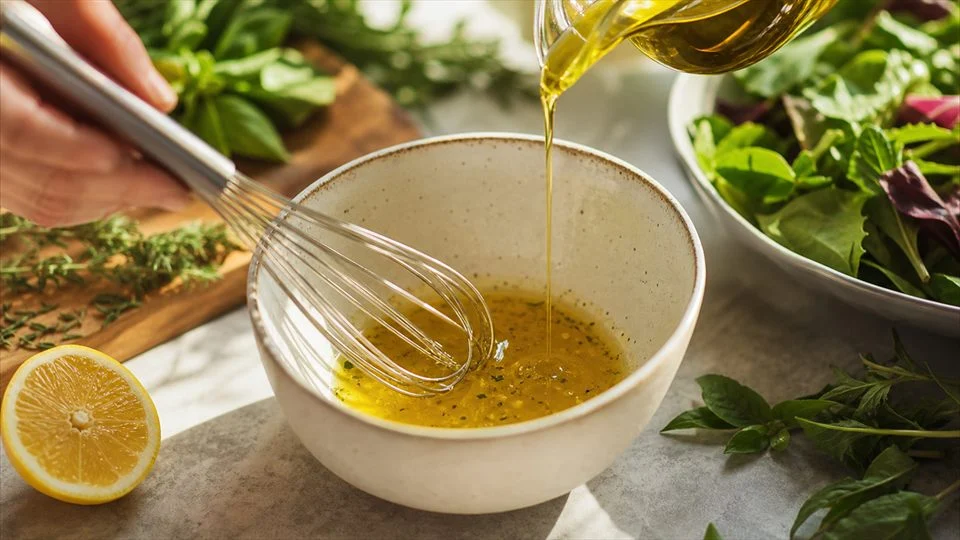
Vinaigrettes, marinades, yoghurt, cheeses, toast, no-cook ice creams. Here honey keeps its enzymes and aromatics, and its varietal character comes through whole. It is the only setting where an expensive monofloral is genuinely justified.
Vinaigrette trick: emulsify the honey with the vinegar or citrus first, and only then add the oil in a thin stream. The other way round it splits.
2. Glazes at the end
Brush on in the last five to ten minutes, never from the start. Fructose caramelises at a lower temperature than sucrose: if it goes into the oven early it burns and turns bitter before the meat is done.
3. Baking, with corrections
Honey is hygroscopic (it holds moisture) and sweeter than sugar. Three obligatory adjustments:
- Replace 100 g of sugar with 75 to 80 g of honey.
- Reduce the liquid in the recipe by about 20 ml for every 80 g of honey.
- Lower the oven by 10 to 15 °C and lengthen the time: honey browns much sooner.
In exchange you get a cake that stays moist several days longer. That is the real advantage.
Which honey for which dish
Orange blossom: dairy desserts, white fruit, brioche doughs, rice pudding.
Rosemary: vinaigrettes, oily fish, roast vegetables, carrot.
Heather: blue cheese, game, dark chocolate, foie.
Honeydew: mature cheeses, rye bread, dark baking, pates.
Eucalyptus: warm infusions, sweet and sour sauces, pork.
Multifloral: general use and cooking: this is the one that should go in the oven.
Pairing with cheese: how not to get it wrong
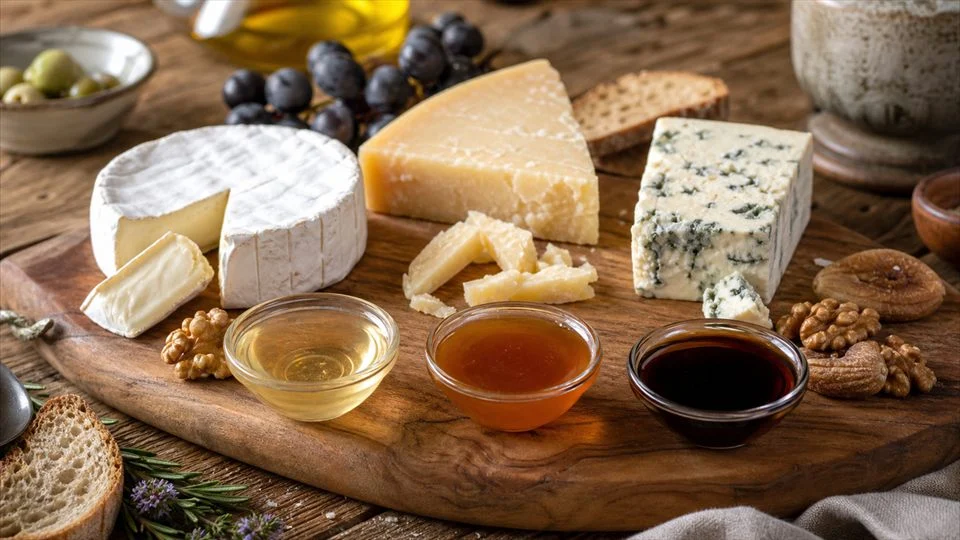
Two opposing principles, both valid. By contrast: a salty, intense cheese with a bitter, balsamic honey, Cabrales with heather. By affinity: a fresh, milky cheese with a soft floral honey, curd cheese with orange blossom.
What never works is the middle ground: a semi-cured cheese with a multifloral honey adds nothing to either of them.
The most expensive mistake
Using a single origin monofloral to sweeten a boiling tea. The heat destroys exactly what you paid for, and the result is indistinguishable from an industrial honey. A multifloral will do for that, and the good one goes cold, the next day, on a piece of toast.
References
- Bogdanov, S., Martin, P. & Lüllmann, C. (International Honey Commission) (2009). Harmonised methods of the International Honey Commission. IHC Platform, Swiss Bee Research Centre. https://www.ihc-platform.net/ihcmethods2009.pdf
- Consejo de la Unión Europea (2001). Directiva 2001/110/CE del Consejo, de 20 de diciembre de 2001, relativa a la miel. Diario Oficial de las Comunidades Europeas, L 10, 47–52. https://eur-lex.europa.eu/legal-content/ES/TXT/?uri=CELEX%3A32001L0110
- EFSA Panel on Additives and Products or Substances used in Animal Feed (2022). Risks for animal health related to the presence of hydroxymethylfurfural (HMF) in feed for honey bees. EFSA Journal, 20(4), e07227. https://www.ncbi.nlm.nih.gov/pmc/articles/PMC9019825/
- Eurofins Scientific (2023). HMF in honey — why do we test for it?. Eurofins Food Testing, technical note. https://www.eurofins.in/food-testing/blog/hmf-in-honey/
- Da Silva, P. M., Gauche, C., Gonzaga, L. V., Costa, A. C. O. & Fett, R. (2016). Sugars in honey. En: Dietary Sugars: Chemistry, Analysis, Function and Effects. Royal Society of Chemistry. https://books.rsc.org/books/edited-volume/1813/chapter/2125161/Sugars-in-Honey
- Escuredo, O., Dobre, I., Fernández-González, M. & Seijo, M. C. (2014). Contribution of botanical origin and sugar composition of honeys on the crystallization phenomenon. Food Chemistry, 149, 84–90. https://www.sciencedirect.com/science/article/abs/pii/S030881461301546X
- FAO & OMS (2022). Standard for Honey (CXS 12-1981, rev. 2022). Codex Alimentarius Commission, Roma. https://www.fao.org/fao-who-codexalimentarius/codex-texts/list-standards/en/