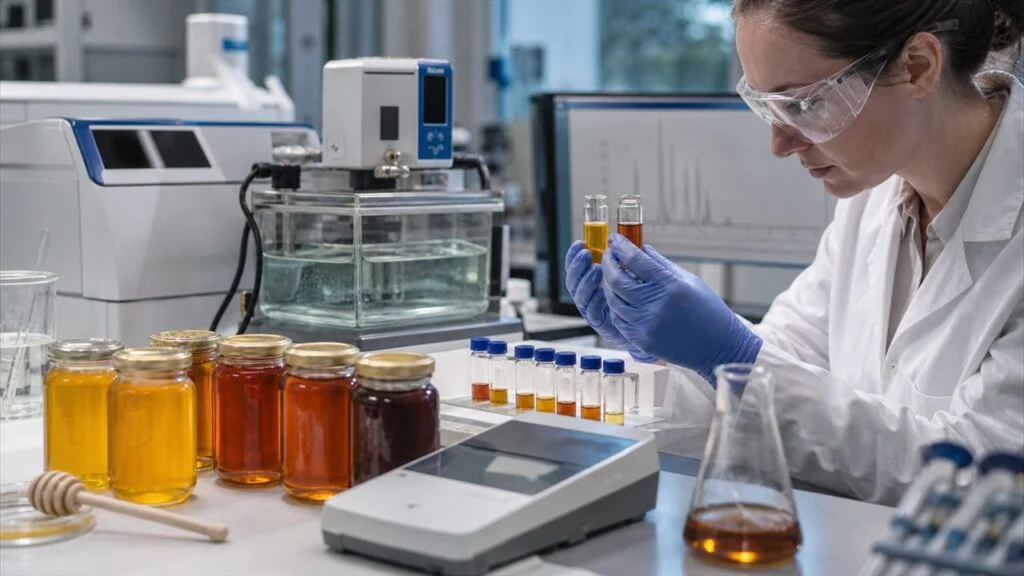
Hydroxymethylfurfural is the fingerprint that heat leaves in honey. It tells us whether a jar has been forced, rushed or badly kept. A low number is worth gold, but sometimes it lies. This is an honest guide to the most important and worst understood analysis in the sector.
What HMF is exactly
5-hydroxymethylfurfural (HMF) is an organic compound formed when the sugars in honey, above all fructose, dehydrate in an acid medium. Honey brings together the three perfect conditions for it to happen: it is acid (pH 3,5 to 4,5), it is loaded with fructose and it contains very little free water.
In a honey just extracted and kept cold, the concentration is practically zero. From there it only rises. It never falls. That irreversibility is precisely what makes it a useful indicator: HMF does not measure quality in the abstract, it measures accumulated thermal history. It is a chemical stopwatch that records every hour that honey has spent above the temperature of the hive.
Three ways to raise HMF
Pasteurisation. Heating to 70 or 80 °C for minutes to delay crystallisation and make filtering easier. It is the fastest route.
Liquefying tanks. Heating crystallised drums so they can be packed. Less aggressive, but repeated over months.
Time and storage. With no added heat, a honey kept at 25 to 30 °C raises its HMF slowly but steadily.
What the regulation says
Council Directive 2001/110/EC, which governs honey in the European Union, sets a general maximum of 40 mg/kg of HMF for honey placed on the market.1 Its annexes also set out the rest of the composition criteria (moisture, sugars, conductivity, free acidity and diastase activity) that legally define the product.2
The rule allows two exceptions:
- 80 mg/kg for honeys of declared tropical origin, because the climate speeds up the formation of HMF naturally.
- 15 mg/kg for honeys with a naturally low enzyme content, where the margin of tolerance has to be smaller.
The international Codex Alimentarius standard keeps equivalent thresholds, so a jar that complies in Brussels also complies in most export markets.3
A nuance that is constantly misread
The 40 mg/kg limit is a criterion of freshness and good practice, not a toxicological threshold. Exceeding it means the honey has been heated or is old; it does not mean it is dangerous. The risk assessment published by EFSA on HMF deals specifically with exposure in feed for honey bees and does not equate the commercial limit with a risk to the consumer.4
It is worth saying plainly because a lot of alarmism circulates: a honey at 45 mg/kg is not toxic. It is, quite simply, a honey that has seen heat.
How it is measured
The reference methods are collected in the Harmonised Methods of the International Honey Commission, the document most European laboratories take as their basis.5 It covers two main routes:
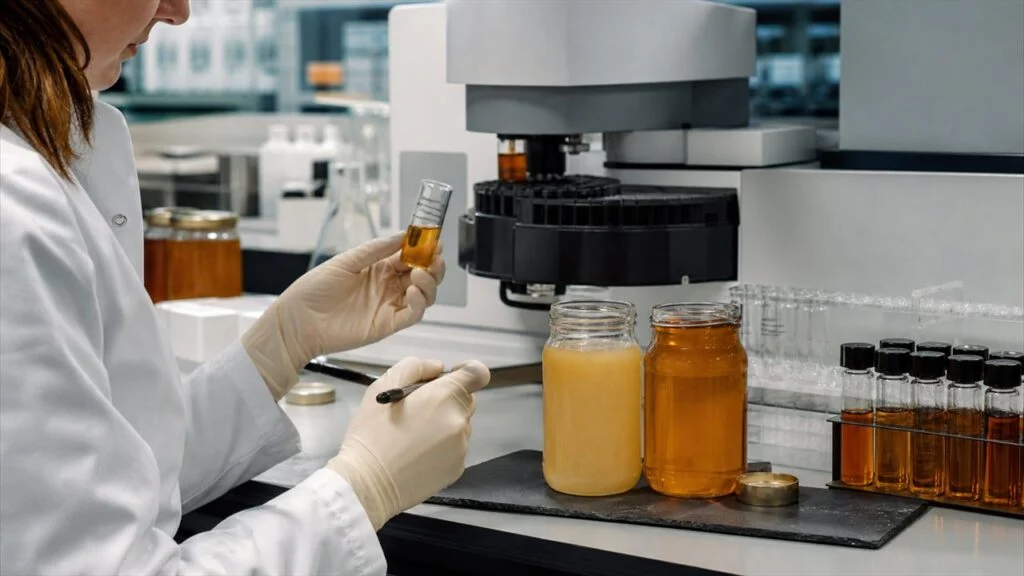
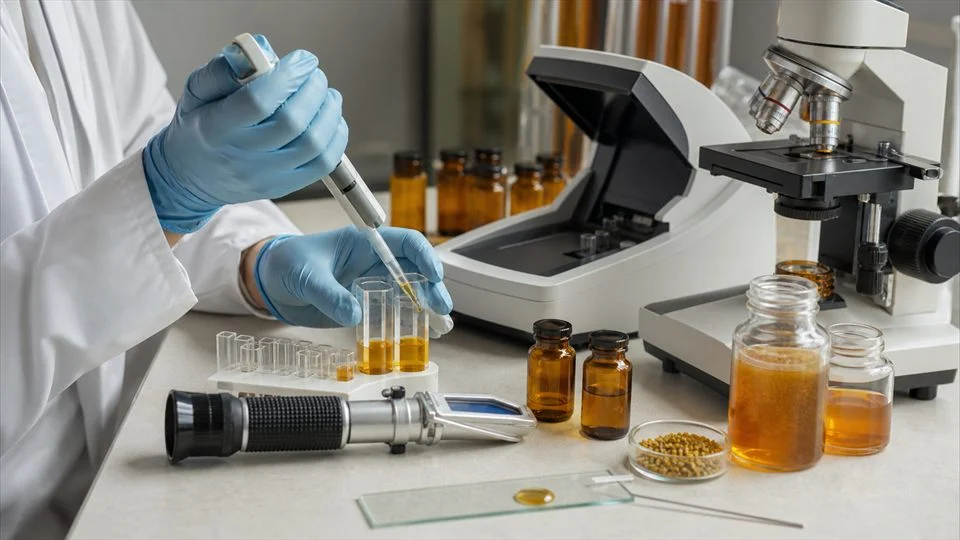
Spectrophotometry (White method). Cheaper and quicker. It measures absorbance at 284 and 336 nm. Enough for routine control.
HPLC, high performance liquid chromatography. More expensive, more precise, and the one required when there is a commercial dispute or a result close to the limit.
HMF never travels alone
A serious report does not give a single number. Alongside HMF, diastase activity is measured, which reflects the enzymes the bee contributes to the honey and that heat destroys. The International Honey Commission describes two procedures, the classic Schade one and the Phadebas method, with good correlation between them.5
The combination of both parameters is what really tells you something:
- Low HMF + high diastase: fresh honey, not forced. What you are looking for.
- High HMF + low diastase: heat, or years in storage. Consistent, and a bad sign.
- Low HMF + low diastase: the combination that forces you to ask questions: it may indicate a honey naturally poor in enzymes, or a blend with syrups.
When the number misleads
A very low HMF does not always mean excellence. There are at least three scenarios where the figure, on its own, leads you astray.
1. Honeys naturally poor in enzymes
Some flowerings produce honeys with low diastase from the start, without any mistreatment at all. That is why the rule provides for that special limit of 15 mg/kg.
2. Blends that average out
An industrial batch can combine a very old honey with a freshly harvested one and land on an acceptable average. The number complies; the product is not what it appears to be.
3. Botanical origin not verified
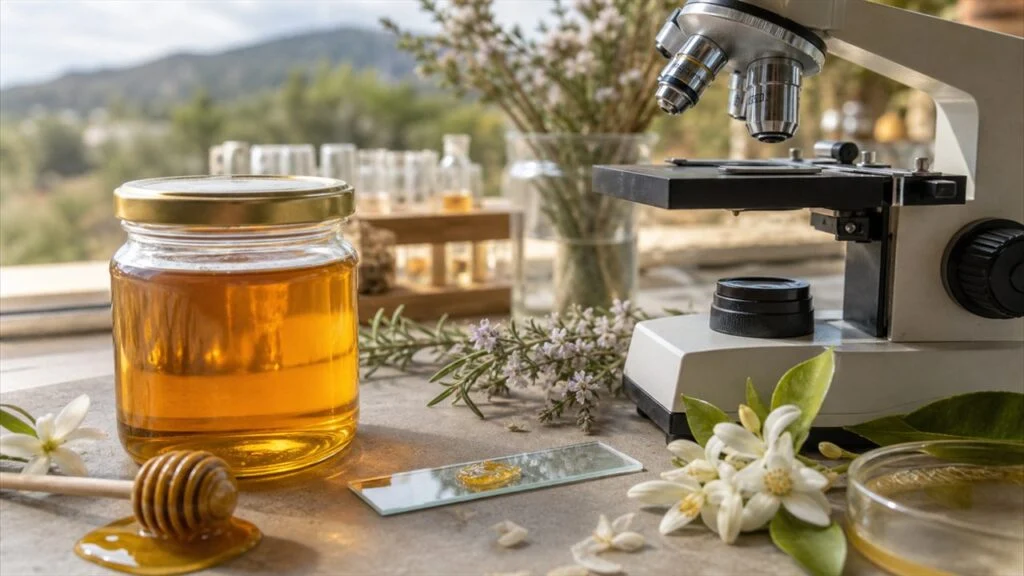
Physicochemical analysis does not say which flower the honey comes from. That is resolved by melissopalynology: the counting and identification of the pollen grains in the sample, whose harmonised methods are the reference standard.6 Work combining pollen profile with physicochemical properties shows how far the two layers complement each other.7
If a honey has been ultrafiltered, that pollen is no longer there, and the floral declaration stops being verifiable.
What you can do at home
You cannot measure HMF without a laboratory, but you can avoid raising it:
- Keep it between 14 and 20 °C, in the dark and with the jar tightly closed. The heat of a kitchen in summer is the worst enemy.
- Never heat it in a microwave. It goes past 60 °C in seconds and unevenly.
- If it crystallises, a water bath below 40 °C. With patience and stirring.
- Do not add it to boiling infusions. Wait for the liquid to drop below 40 °C.
Various works have documented the rise in HMF during prolonged storage, and temperature is the dominant variable.8
What we ask of ourselves
At Melisa we analyse every batch before packing it and we publish the code on the label. Our internal criterion is stricter than the legal one, because we work with cold extraction and without pasteurising: if a honey of ours came close to the limit of 40 mg/kg, something would have failed in the chain.
It is not a marketing promise. It is, quite simply, what not heating honey means, and accepting in exchange that it crystallises sooner, that filtering is slower and that output per hour of workshop is worse.
References
- Consejo de la Unión Europea (2001). Directiva 2001/110/CE del Consejo, de 20 de diciembre de 2001, relativa a la miel. Diario Oficial de las Comunidades Europeas, L 10, 47–52. https://eur-lex.europa.eu/legal-content/ES/TXT/?uri=CELEX%3A32001L0110
- Consejo de la Unión Europea (2001). Directiva 2001/110/CE, Anexo II: criterios de composición de la miel. Legislation.gov.uk (EU retained law). https://www.legislation.gov.uk/eudr/2001/110/annex/II
- FAO & OMS (2022). Standard for Honey (CXS 12-1981, rev. 2022). Codex Alimentarius Commission, Roma. https://www.fao.org/fao-who-codexalimentarius/codex-texts/list-standards/en/
- EFSA Panel on Additives and Products or Substances used in Animal Feed (2022). Risks for animal health related to the presence of hydroxymethylfurfural (HMF) in feed for honey bees. EFSA Journal, 20(4), e07227. https://www.ncbi.nlm.nih.gov/pmc/articles/PMC9019825/
- Bogdanov, S., Martin, P. & Lüllmann, C. (International Honey Commission) (2009). Harmonised methods of the International Honey Commission. IHC Platform, Swiss Bee Research Centre. https://www.ihc-platform.net/ihcmethods2009.pdf
- Von Der Ohe, W., Persano Oddo, L., Piana, M. L., Morlot, M. & Martin, P. (2004). Harmonized methods of melissopalynology. Apidologie, 35(S1), S18–S25. https://www.academia.edu/121979867/Harmonized_methods_of_melissopalynology
- Tafere, D. A., et al. (2020). Melissopalynology and antioxidant properties used to differentiate Schefflera abyssinica and polyfloral honey. PLOS ONE, 15(10), e0240868. https://journals.plos.org/plosone/article?id=10.1371%2Fjournal.pone.0240868
- Eurofins Scientific (2023). HMF in honey — why do we test for it?. Eurofins Food Testing, technical note. https://www.eurofins.in/food-testing/blog/hmf-in-honey/