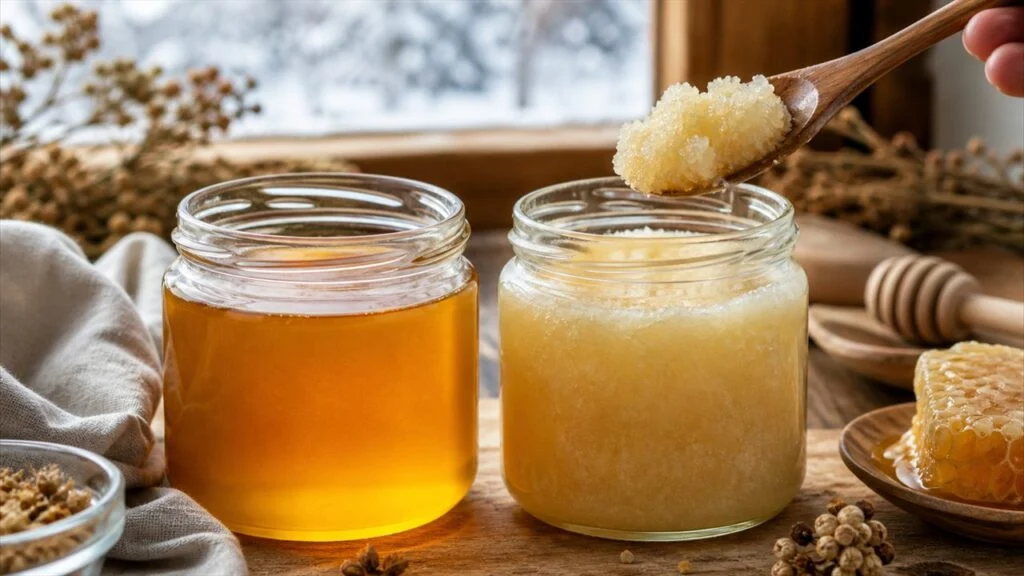
Every winter we get the same email: it has gone hard, is it off? No. It is doing exactly what an untreated honey does. The odd one, in truth, is the honey that stays liquid for ever.
A honey is a supersaturated solution
Honey holds more sugar than the water in it could keep dissolved under normal conditions. It is an unstable balance by definition: sooner or later part of the glucose leaves the solution and forms crystals. That is crystallising. It is not fermenting, it is not expiring, it is not sugaring through adulteration.
The speed depends above all on the glucose to fructose ratio of each bloom. The literature has linked botanical origin and sugar composition directly to the crystallisation phenomenon.1 The review of honey sugars sets out that chemical basis.2
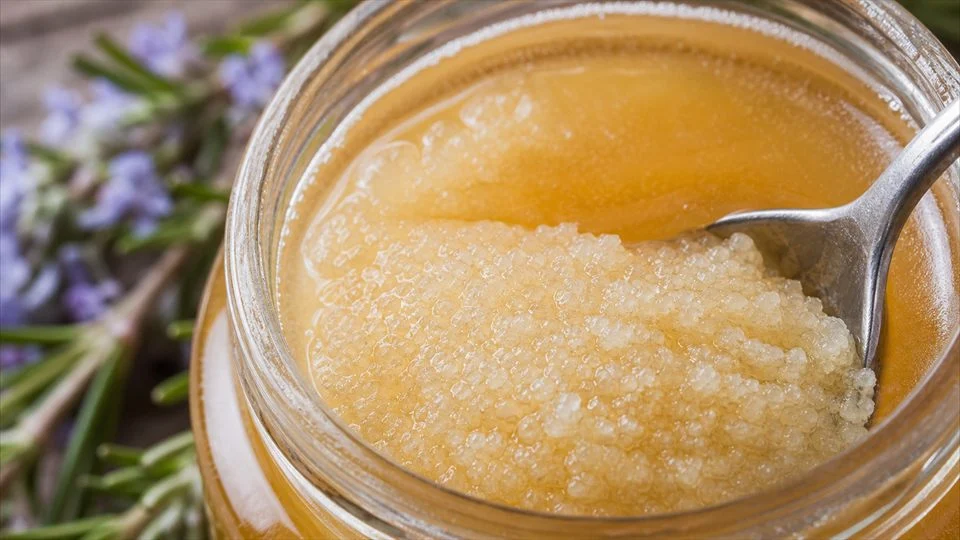
Why some do and some do not
Plenty of glucose → crystallises fast. Sunflower, rapeseed, heather, dandelion. Weeks, sometimes days.
Plenty of fructose → stays liquid. Acacia, chestnut, many honeydew honeys. Months, or more than a year.
Honeydew honeys also have a low glucose to water ratio that delays the process, although those rich in melezitose do exactly the opposite and crystallise in the comb itself.3
Temperature rules
The point of maximum crystallisation speed is around 14 °C. Above 25 °C the process slows, but degradation speeds up; below 5 °C it also slows, but the texture turns gritty. A pantry at 18 to 20 °C is the best compromise.
What you must NOT do
Microwave. It heats unevenly, passes 60 °C in seconds and destroys enzymes. It also sends hydroxymethylfurfural up, the marker European rules cap at 40 mg/kg.4
Boiling water. The same problem, slower, with a false sense of control.
Putting it in the fridge. It speeds crystallisation up and turns it grainy.
Throwing it away. It is perfectly fine.
What does work
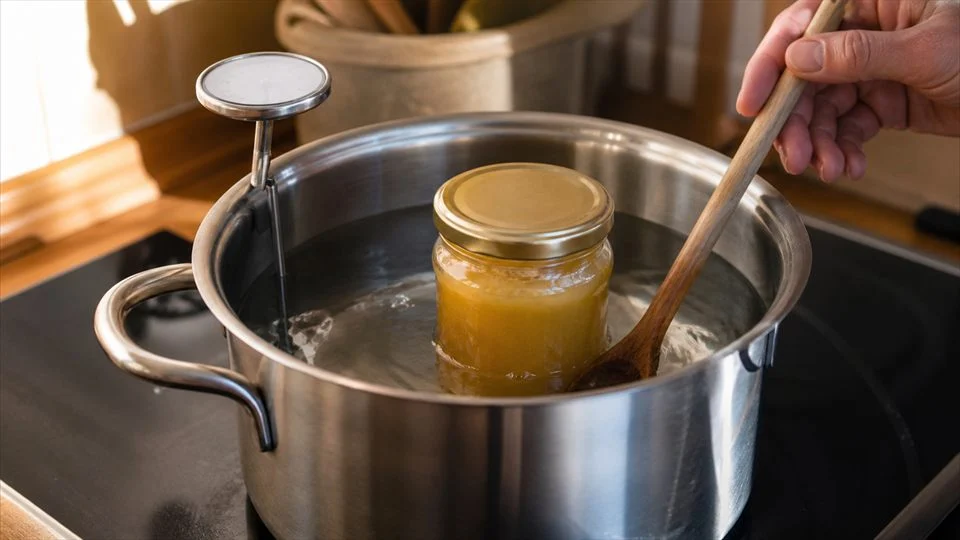
A bain-marie with a thermometer, below 40 °C, stirring every few minutes. It takes between 20 and 40 minutes depending on the size of the jar. Or simply eat it crystallised: on toast it is better than liquid, because it does not run off.
Directed crystallisation: creamed honey
There is a third way, which is not about avoiding crystallisation but controlling it. By seeding a liquid honey with a small percentage of already crystallised, fine grained honey and stirring cold over several days, you obtain a smooth, homogeneous texture.
It is a purely physical process: nothing is heated, nothing is filtered, nothing is added. And it gives the best result in high glucose honeys that were going to set anyway.
A signal, not a defect
A honey that never crystallises has usually been pasteurised and microfiltered: heated to dissolve the crystal nuclei and filtered to remove particles and pollen. The result is a product that is stable on the shelf and poorer in the jar.
And there is a rarely mentioned consequence: without pollen there is no possible verification of botanical origin, because melissopalynology, the reference method, needs precisely those grains to work.5
References
- Escuredo, O., Dobre, I., Fernández-González, M. & Seijo, M. C. (2014). Contribution of botanical origin and sugar composition of honeys on the crystallization phenomenon. Food Chemistry, 149, 84–90. https://www.sciencedirect.com/science/article/abs/pii/S030881461301546X
- Da Silva, P. M., Gauche, C., Gonzaga, L. V., Costa, A. C. O. & Fett, R. (2016). Sugars in honey. En: Dietary Sugars: Chemistry, Analysis, Function and Effects. Royal Society of Chemistry. https://books.rsc.org/books/edited-volume/1813/chapter/2125161/Sugars-in-Honey
- Bong, J., et al. (2021). Composition and potential as a prebiotic functional food of a Giant Willow Aphid honeydew honey produced in New Zealand. Food Chemistry, 345, 128739. https://www.sciencedirect.com/science/article/abs/pii/S0308814620325243
- Consejo de la Unión Europea (2001). Directiva 2001/110/CE del Consejo, de 20 de diciembre de 2001, relativa a la miel. Diario Oficial de las Comunidades Europeas, L 10, 47–52. https://eur-lex.europa.eu/legal-content/ES/TXT/?uri=CELEX%3A32001L0110
- Von Der Ohe, W., Persano Oddo, L., Piana, M. L., Morlot, M. & Martin, P. (2004). Harmonized methods of melissopalynology. Apidologie, 35(S1), S18–S25. https://www.academia.edu/121979867/Harmonized_methods_of_melissopalynology
- Bogdanov, S., Martin, P. & Lüllmann, C. (International Honey Commission) (2009). Harmonised methods of the International Honey Commission. IHC Platform, Swiss Bee Research Centre. https://www.ihc-platform.net/ihcmethods2009.pdf
- FAO & OMS (2022). Standard for Honey (CXS 12-1981, rev. 2022). Codex Alimentarius Commission, Roma. https://www.fao.org/fao-who-codexalimentarius/codex-texts/list-standards/en/