Forget the spoon. Forget what you were told as a child about sweet and tasty. Honey is tasted the way wine is: with memory, method and a clean glass. Six steps, a notebook and a promise to correct nobody at the table.
Why the spoon is poor company
A metal spoon cools the sample, adds a metallic edge and forces you to take too much at once. The result is predictable: all you perceive is sweetness, which in a honey is the least interesting fact of all. Every honey is sweet. What sets one apart is the rest: acidity, bitterness, persistence, aftertaste.
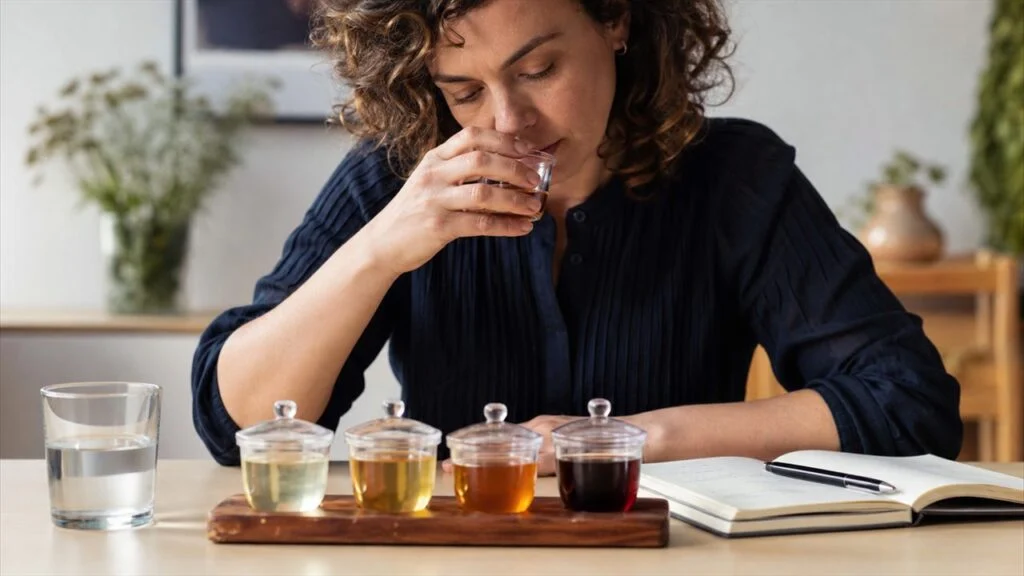
Professional tasting uses a colourless glass vessel with a lid and a sample brought to temperature. The sensory methodology applied to honey is described, alongside the physicochemical parameters, in the harmonised methods of the International Honey Commission.1
Setting the table
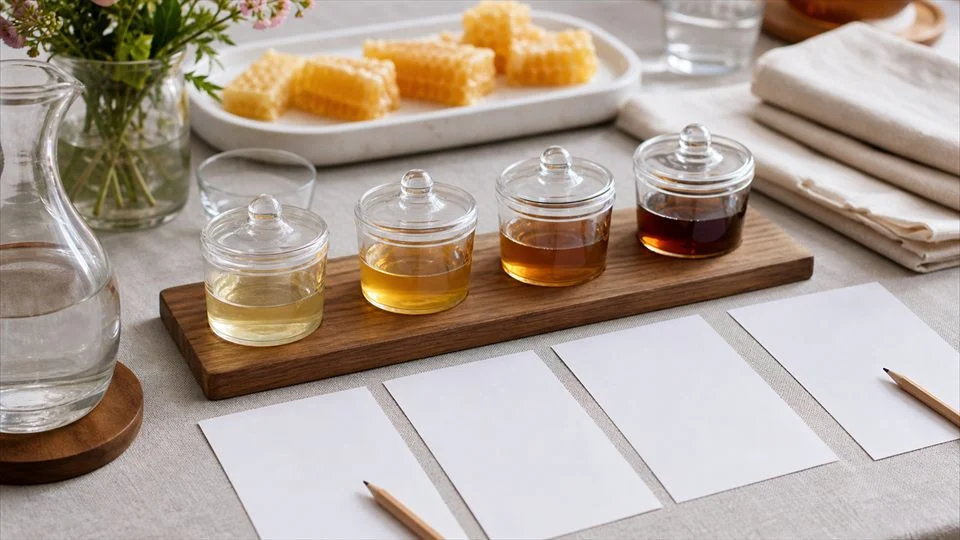
Before the first glass it is worth settling four things: time of day (mid morning, with a clean palate), order (from mild to intense, never the other way round), number (four samples is the sensible limit before sensory fatigue sets in) and silence (nobody names anything out loud until everyone has written it down).
That last point ruins more tastings than any other. The moment somebody says “it smells of liquorice”, the whole table smells liquorice.
The six steps
1. Temperature
Bring the sample to 20 to 25 °C. Cold, honey hides its aromatics; hot, it distorts them. And once you pass 40 °C you start generating hydroxymethylfurfural and degrading enzymes, exactly what a good producer has spent the whole chain avoiding.2
2. Sight
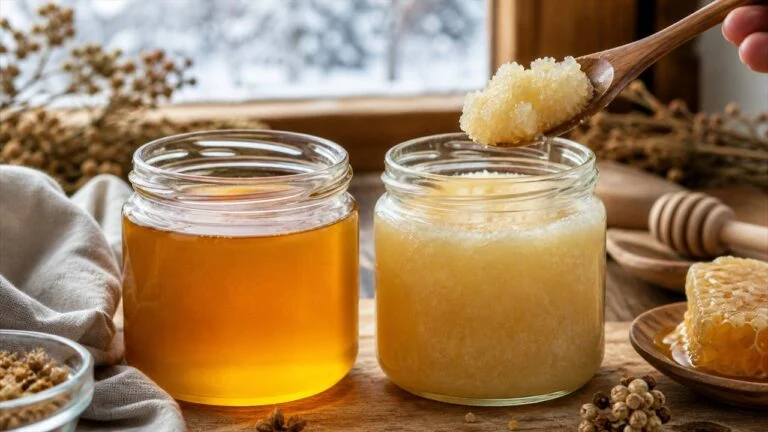
Look at colour, clarity and the state of crystallisation. Crystallisation is not a defect: it depends on the glucose to fructose ratio of each bloom, and that ratio is tied directly to botanical origin.3 A sunflower honey crystallises in weeks; an acacia can take more than a year.
3. Direct smell
Uncover and smell in two stages: one short breath, then a long, deep one. Write before you speak. If the word will not come, describe the sensation: “it reminds me of my grandmother’s wardrobe” is perfectly valid data.
4. Mouth
A small amount, spread across the whole palate with the tongue. Look for structure before aroma: acidity, bitterness, saltiness, astringency. Heather turns bitter; chestnut turns salty and bitter; orange blossom sharpens; honeydew leaves a mineral base.
5. The retronasal route
With your mouth closed, push air gently out through your nose. Most of the aromatic profile appears here: it is the real difference between perceiving “honey” and perceiving “high mountain lavender honey”.
6. Persistence
Count the seconds the aroma stays with you after swallowing. A quality monofloral holds between 20 and 40 seconds with a clean aftertaste. If it disappears in five, or leaves an echo of burnt caramel, there is something to explain.
The minimum vocabulary
You do not need a huge lexicon; you need a shared one. Four families are enough to begin:
- Floral: orange blossom, lime blossom, broom, white flower.
- Fruity: citrus, dried fruit, fig, quince.
- Vegetal and balsamic: eucalyptus, resin, hay, damp wood.
- Toasted: caramel, malt, liquorice, cocoa.
If a honey fits none of them, the honey is not at fault: the vocabulary is short. Write it down in your own words and come back to that sheet at the next tasting. In six months you will have a language of your own, and a consistent one.
Botanical origin: when the palate is not enough
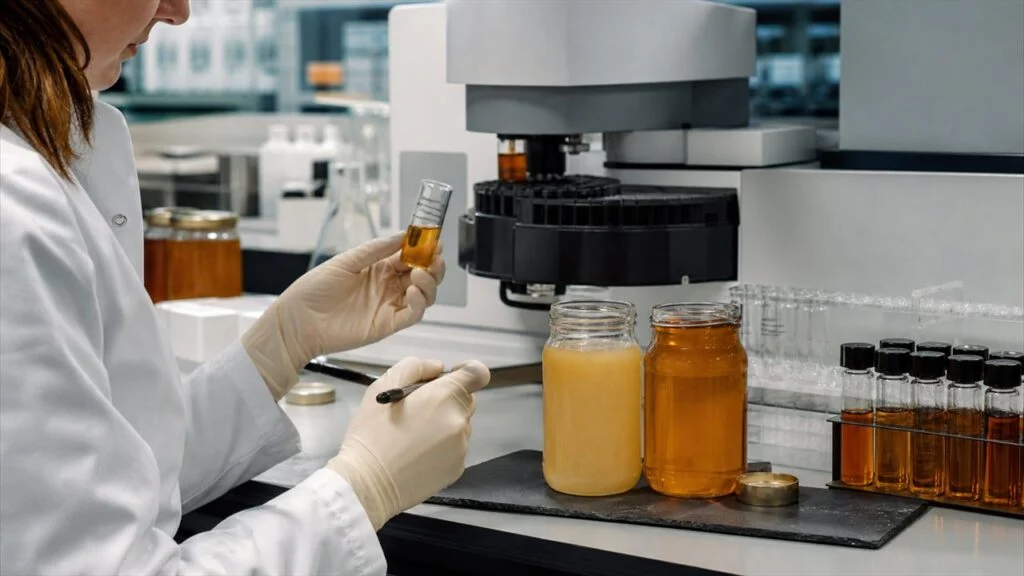
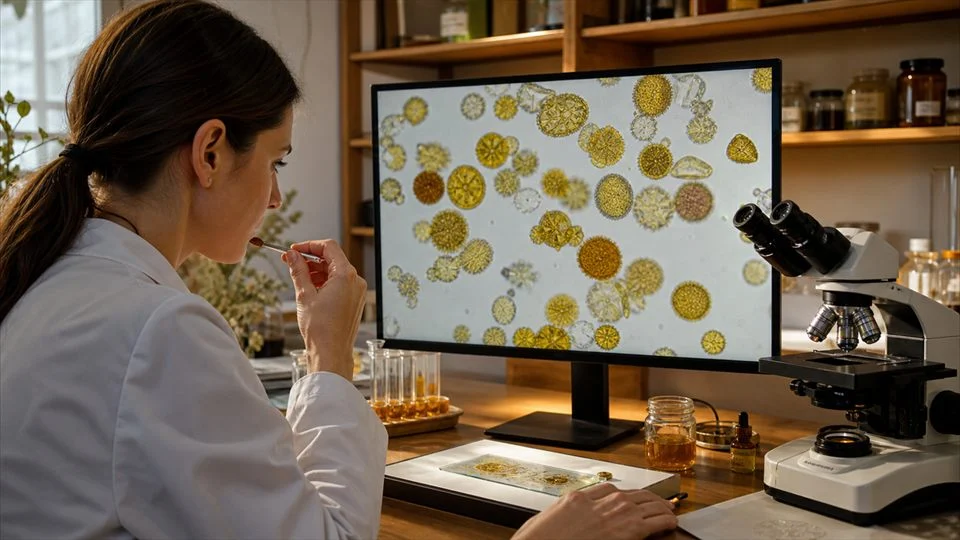
A trained nose is right more often than not, but it does not certify. Botanical origin is verified by pollen analysis (melissopalynology), counting and identifying the pollen grains in the sample; it is the reference method for supporting a monofloral claim.4 Work combining the pollen profile with physicochemical properties shows how far the two layers complement one another.5
Four mistakes that ruin a tasting
Tasting after a meal. The palate arrives biased and saturated.
Starting with the most intense. Heather or honeydew cancel out everything that follows.
Tasting more than four. Beyond that the sense of smell tires and everything tastes the same.
Hunting for the “correct” answer. A tasting records perceptions, it does not mark exams.
And afterwards, the table
Tasting exists so that you eat better. A bitter, balsamic honey asks for blue cheese; a light floral one, yoghurt and fresh fruit; a dark honeydew, game meat or sourdough bread with salted butter.
The rule is simple: pair by contrast or by affinity, never by habit.
References
- Bogdanov, S., Martin, P. & Lüllmann, C. (International Honey Commission) (2009). Harmonised methods of the International Honey Commission. IHC Platform, Swiss Bee Research Centre. https://www.ihc-platform.net/ihcmethods2009.pdf
- Consejo de la Unión Europea (2001). Directiva 2001/110/CE del Consejo, de 20 de diciembre de 2001, relativa a la miel. Diario Oficial de las Comunidades Europeas, L 10, 47–52. https://eur-lex.europa.eu/legal-content/ES/TXT/?uri=CELEX%3A32001L0110
- Escuredo, O., Dobre, I., Fernández-González, M. & Seijo, M. C. (2014). Contribution of botanical origin and sugar composition of honeys on the crystallization phenomenon. Food Chemistry, 149, 84–90. https://www.sciencedirect.com/science/article/abs/pii/S030881461301546X
- Von Der Ohe, W., Persano Oddo, L., Piana, M. L., Morlot, M. & Martin, P. (2004). Harmonized methods of melissopalynology. Apidologie, 35(S1), S18–S25. https://www.academia.edu/121979867/Harmonized_methods_of_melissopalynology
- Tafere, D. A., et al. (2020). Melissopalynology and antioxidant properties used to differentiate Schefflera abyssinica and polyfloral honey. PLOS ONE, 15(10), e0240868. https://journals.plos.org/plosone/article?id=10.1371%2Fjournal.pone.0240868
- FAO & OMS (2022). Standard for Honey (CXS 12-1981, rev. 2022). Codex Alimentarius Commission, Roma. https://www.fao.org/fao-who-codexalimentarius/codex-texts/list-standards/en/
- Da Silva, P. M., Gauche, C., Gonzaga, L. V., Costa, A. C. O. & Fett, R. (2016). Sugars in honey. En: Dietary Sugars: Chemistry, Analysis, Function and Effects. Royal Society of Chemistry. https://books.rsc.org/books/edited-volume/1813/chapter/2125161/Sugars-in-Honey