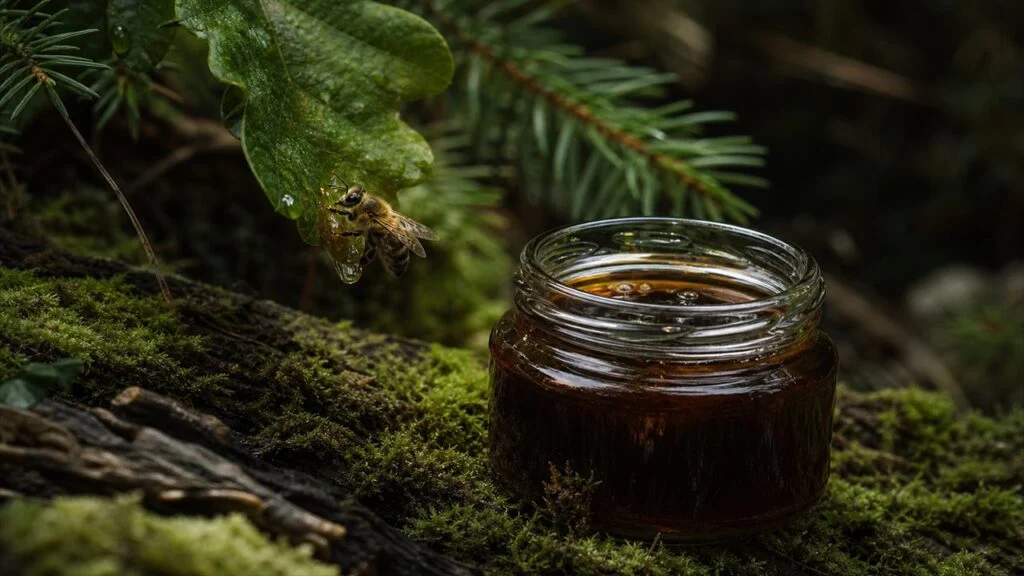
There is a honey that comes from no flower at all. It leaves an aphid, passes through a fir tree and ends up the darkest, most mineral and most disconcerting jar in the cupboard. It is called honeydew honey, and it deserves a long explanation.
A sugar that has already passed through another animal
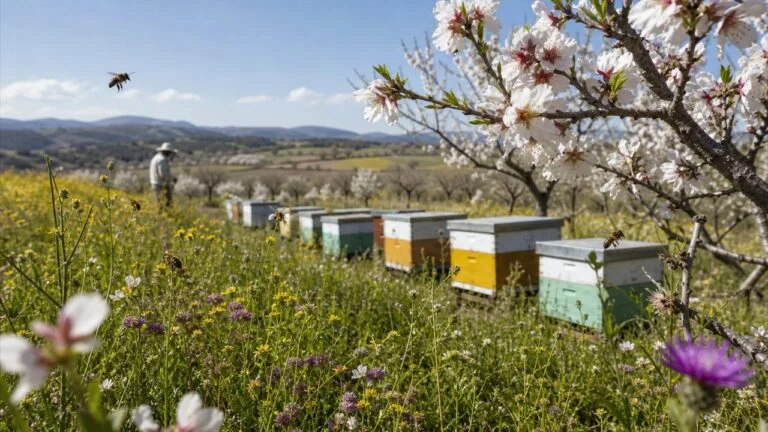
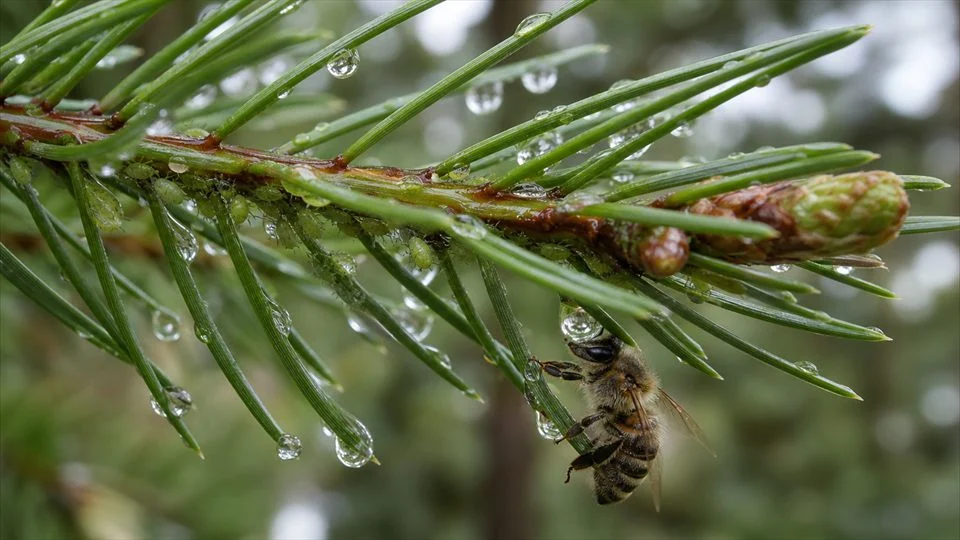
Bees do not always gather nectar. In summer, when the bloom runs out and the countryside dries, they collect honeydew: the sugary liquid that aphids and scale insects excrete after feeding on the elaborated sap of holm oaks, oaks, firs or pines.
The insect needs the proteins in the sap and discards most of the sugar. That drop falls on the leaf, and the bee gathers it. Hence the English name honeydew, literally a dew of honey.
That double origin (plant, insect, bee) leaves an unmistakable chemical signature. Honeydew honeys show a higher fructose to glucose ratio, fewer total monosaccharides (around 45% against the 60 to 80% of a floral honey) and considerably more di and oligosaccharides, between 8 and 30%.1
Melezitose, the problem molecule
The compound that defines many honeydew honeys is melezitose, a trisaccharide made of two glucoses and one fructose. In some honeydews it can account for as much as 43% of the sugars, well ahead of sucrose.2
For the beekeeper it is a familiar curse: melezitose crystallises inside the comb, with a hardness that makes extraction by centrifuge impossible. It is known as cement honey, and it forces whole frames to be melted down.
And it is not harmless to the colony
Research has documented the impact of melezitose on bees and their gut microbiota: overwintering on stores rich in this sugar is associated with digestive problems and higher winter mortality.3 Work on its production in honeydew points in the same direction.4
That is why a beekeeper working honeydew removes the honeydew stores before winter and leaves the colony floral honey or syrup. It is not a whim: it is survival.
Why it tastes of forest and not of flowers
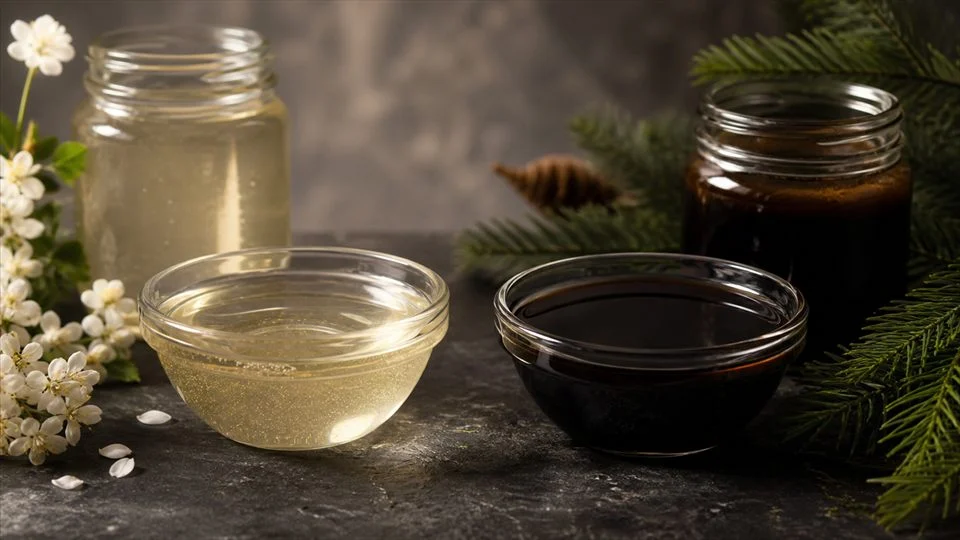
The sensory profile has nothing floral about it: resin, malt, dried fig, liquorice, a saline and sometimes meaty base. The colour runs from dark amber to almost black.
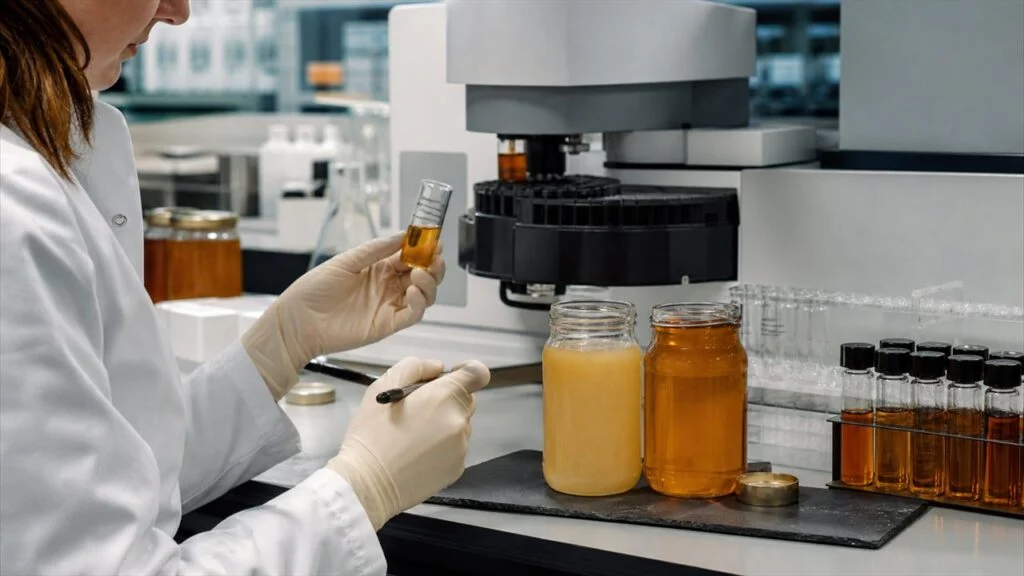
The parameter European rules use to tell it apart is electrical conductivity, markedly higher than in a nectar honey because of its greater mineral content; the annexes to Directive 2001/110/EC set the threshold separating the two categories.5
A figure that surprises
Honeydew honeys tend to have more minerals and greater antioxidant capacity than pale honeys. The popular belief that the paler the purer is exactly the reverse of what the composition says.
How to use it at the table
Do not put it in a mild yoghurt: it will swallow it whole. It works with mature and blue cheeses, game meats, pates, rye bread, and as a partial substitute for brown sugar in dark baking: spice bread, chocolate sponge, ginger biscuits.
In an infusion, always below 40 °C, like any raw honey.
How to recognise a good honeydew honey
- Colour very dark, almost opaque against the light.
- Aroma of resin and wood, with no sweet floral notes.
- Texture dense, crystallising slowly or not at all depending on the sugar profile.
- Label saying honeydew honey or forest honey with a specific region, not simply dark honey.
References
- Bong, J., et al. (2021). Composition and potential as a prebiotic functional food of a Giant Willow Aphid honeydew honey produced in New Zealand. Food Chemistry, 345, 128739. https://www.sciencedirect.com/science/article/abs/pii/S0308814620325243
- ScienceDirect Topics (2023). Melezitose: an overview. Elsevier, Biochemistry, Genetics and Molecular Biology. https://www.sciencedirect.com/topics/biochemistry-genetics-and-molecular-biology/melezitose
- Seeburger, V. C., et al. (2020). The trisaccharide melezitose impacts honey bees and their intestinal microbiota. PLOS ONE, 15(4), e0230871. https://journals.plos.org/plosone/article?id=10.1371%2Fjournal.pone.0230871
- Seeburger, V. C., D’Alvise, P., Schweikert, K. & Hasselmann, M. (2021). The production of melezitose in honeydew and its impact on honey bees (Apis mellifera L.). ResearchGate preprint. https://www.researchgate.net/publication/351371008_The_production_of_melezitose_in_honeydew_and_its_impact_on_honey_bees_Apis_mellifera_L
- Consejo de la Unión Europea (2001). Directiva 2001/110/CE, Anexo II: criterios de composición de la miel. Legislation.gov.uk (EU retained law). https://www.legislation.gov.uk/eudr/2001/110/annex/II
- Da Silva, P. M., Gauche, C., Gonzaga, L. V., Costa, A. C. O. & Fett, R. (2016). Sugars in honey. En: Dietary Sugars: Chemistry, Analysis, Function and Effects. Royal Society of Chemistry. https://books.rsc.org/books/edited-volume/1813/chapter/2125161/Sugars-in-Honey
- Bogdanov, S., Martin, P. & Lüllmann, C. (International Honey Commission) (2009). Harmonised methods of the International Honey Commission. IHC Platform, Swiss Bee Research Centre. https://www.ihc-platform.net/ihcmethods2009.pdf
- Escuredo, O., Dobre, I., Fernández-González, M. & Seijo, M. C. (2014). Contribution of botanical origin and sugar composition of honeys on the crystallization phenomenon. Food Chemistry, 149, 84–90. https://www.sciencedirect.com/science/article/abs/pii/S030881461301546X