Almost everything has been said about royal jelly: that it lengthens life, improves fertility, sustains the immune system. What we know with certainty is less spectacular and rather more interesting, including the fact that it has caused serious reactions in people with asthma.
A food that makes queens
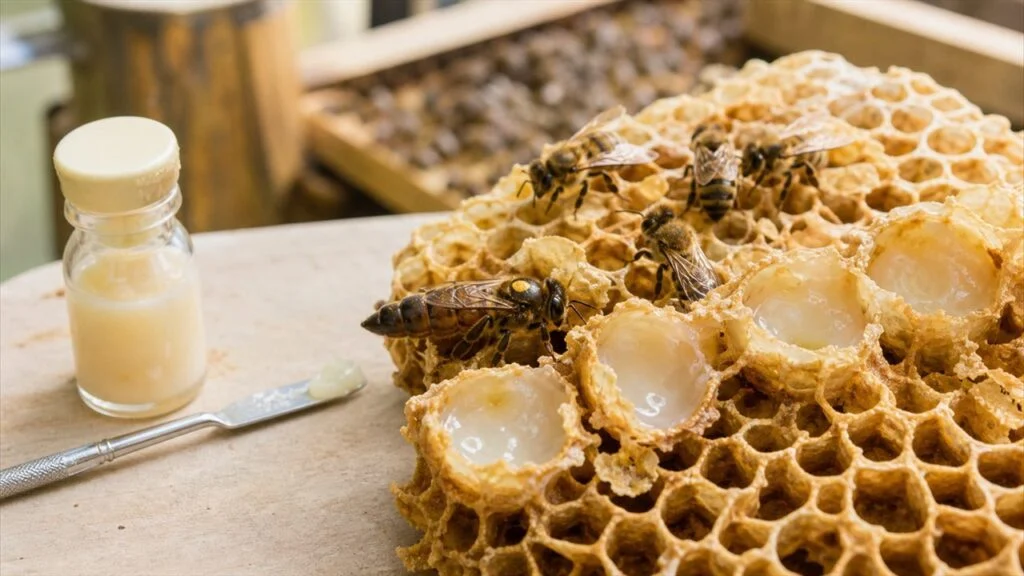
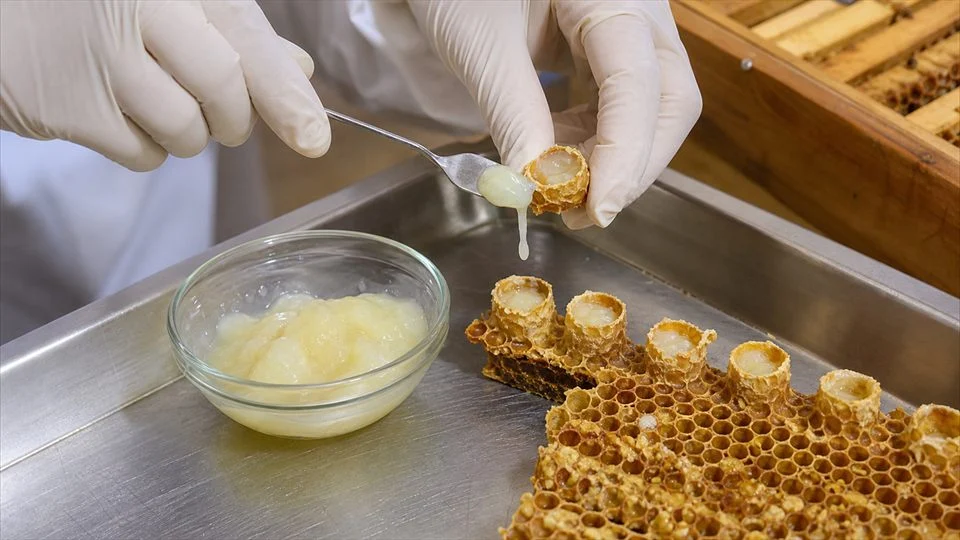
Royal jelly is the secretion of the hypopharyngeal glands of nurse bees. Every larva receives it for the first few days; only the one destined to be queen goes on eating it for life. That difference in diet turns a genetically identical individual into a larger, fertile and longer lived animal. The fact is real, and it is the origin of almost all the commercial mythology around the product.
Chemically it is water, proteins (the royalactins), sugars, lipids and a fatty acid of its own, 10-HDA, which is used as a marker of authenticity and freshness.
What the literature says
Recent reviews are abundant and agree on the catalogue: antioxidant, anti-inflammatory, antibacterial activity and metabolic effects in experimental models.12 A review focused on its bioactive properties details the antitumour and anti-inflammatory mechanisms studied so far,3 and another deals specifically with its antibacterial activity as a nutraceutical.4
The qualification that matters
Those reviews should be read for what they are. Most of the evidence comes from cell and animal studies; human trials are few, with small samples, disparate doses and non standardised products. A systematic review can gather dozens of papers and still conclude that better trials are needed, and that is exactly what happens here.2
Our position: royal jelly is a complementary food with a singular composition, not a treatment. Anyone selling it to you as therapy for a specific disease is running ahead of the data.
The risk that does not appear in the leaflets
Here the clinical evidence is firm, and it runs contrary to the marketing. A paper published in the Journal of Allergy and Clinical Immunology characterised the cases of asthma and anaphylaxis induced by royal jelly and their immunological correlates.5 The same group later described the full clinical series, with an explicit warning for asthmatic and atopic people.6
Occupational asthma from inhalation has also been documented in those who handle it, with cross reactivity to bee venom.7 In other words, sensitisation can arrive by a route other than the one you expect.
Who should abstain or ask first
People with asthma, especially if it is poorly controlled.
People with atopy or a known allergy to bee venom or other hive products.
Children under one year old, for the same reason as honey: no hive products are given to them.
Pregnancy, breastfeeding or chronic treatment: ask first, not because there is a specific alarm, but because there is not enough data to state that there is none.
How to keep it
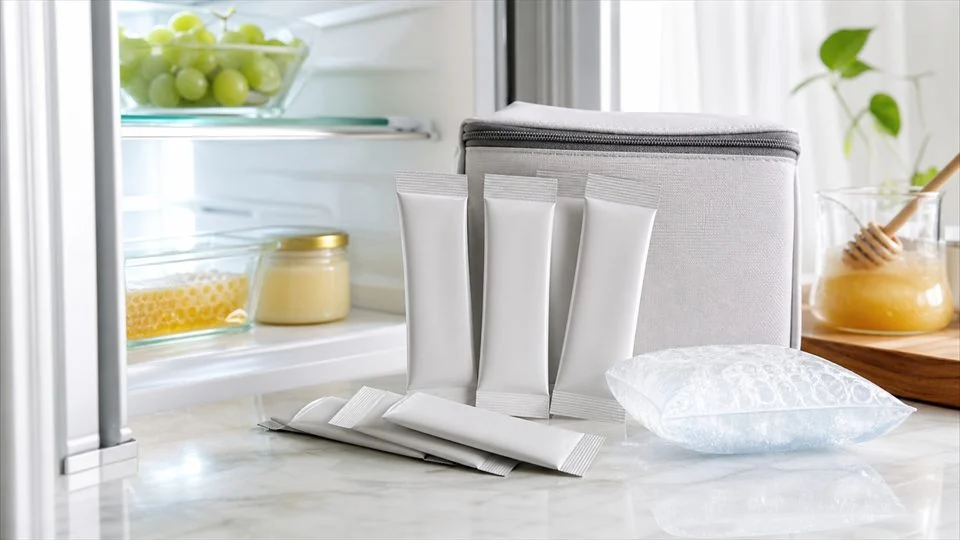
Fresh royal jelly is unstable: it loses 10-HDA to heat and light. Refrigerated and in an opaque container it holds; at room temperature in a clear jar it does not. If a product never requires cold at any point in the chain, ask what form it is in.
References
- Oršolić, N., & Jazvinšćak Jembrek, M. (2024). Royal jelly: biological action and health benefits. International Journal of Molecular Sciences, 25(11), 6023. https://pubmed.ncbi.nlm.nih.gov/38892209/
- Kumar, R., Thakur, A., Kumar, S., & Hajam, Y. A. (2024). Royal jelly a promising therapeutic intervention and functional food supplement: a systematic review. Heliyon, 10(17), e37138. https://pubmed.ncbi.nlm.nih.gov/39296128/
- Botezan, S., Baci, G. M., Bagameri, L., Pașca, C., & Dezmirean, D. S. (2023). Current status of the bioactive properties of royal jelly: a comprehensive review with a focus on its anticancer, anti-inflammatory and antioxidant effects. Molecules, 28(3), 1510. https://pubmed.ncbi.nlm.nih.gov/36771175/
- Bagameri, L., Baci, G. M., & Dezmirean, D. S. (2022). Royal jelly as a nutraceutical natural product with a focus on its antibacterial activity. Pharmaceutics, 14(6), 1142. https://pubmed.ncbi.nlm.nih.gov/35745715/
- Leung, R., Thien, F. C., Baldo, B., & Czarny, D. (1995). Royal jelly-induced asthma and anaphylaxis: clinical characteristics and immunologic correlations. Journal of Allergy and Clinical Immunology, 96(6 Pt 1), 1004-1007. doi:10.1016/S0091-6749(95)70242-3. https://pubmed.ncbi.nlm.nih.gov/8543734/
- Thien, F. C., Leung, R., Baldo, B. A., Weiner, J. A., Plomley, R., & Czarny, D. (1996). Asthma and anaphylaxis induced by royal jelly. Clinical and Experimental Allergy, 26(2), 216-222. https://pubmed.ncbi.nlm.nih.gov/8835130/
- Li, L. S., & Guan, K. (2016). Occupational asthma caused by inhalable royal jelly and its cross-reactivity with honeybee venom. Chinese Medical Journal, 129(23), 2888-2889. https://pmc.ncbi.nlm.nih.gov/articles/PMC5146803/