Propolis is the closest thing a hive has to an immune system. Bees make it to seal cracks and mummify intruders, not to cure us. This is an honest reading of what has been demonstrated, what is still laboratory work, and why a minority of people react to it badly.
What it actually is
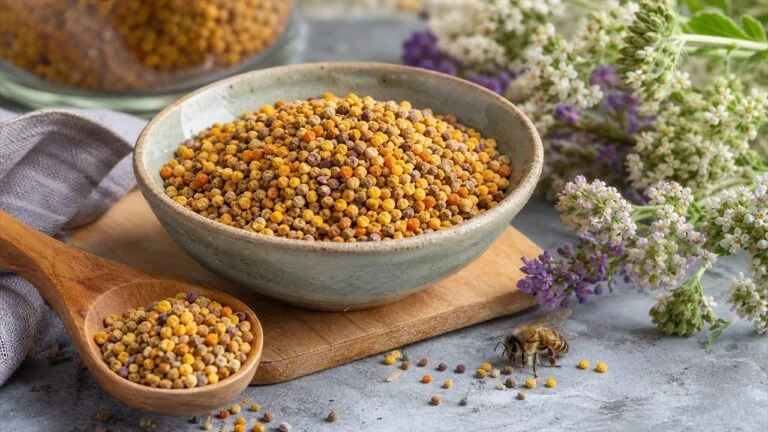
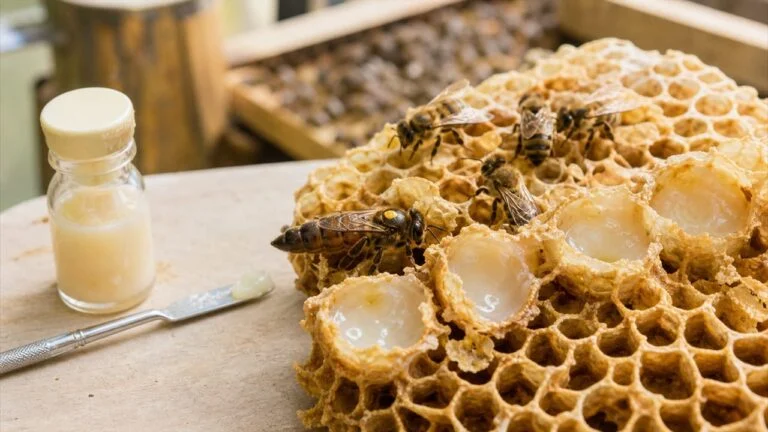
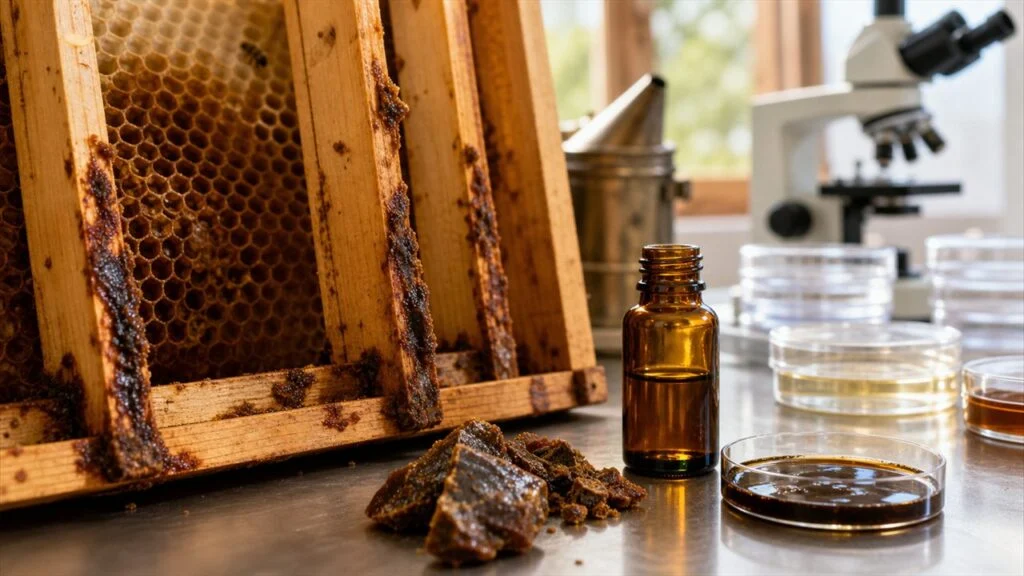
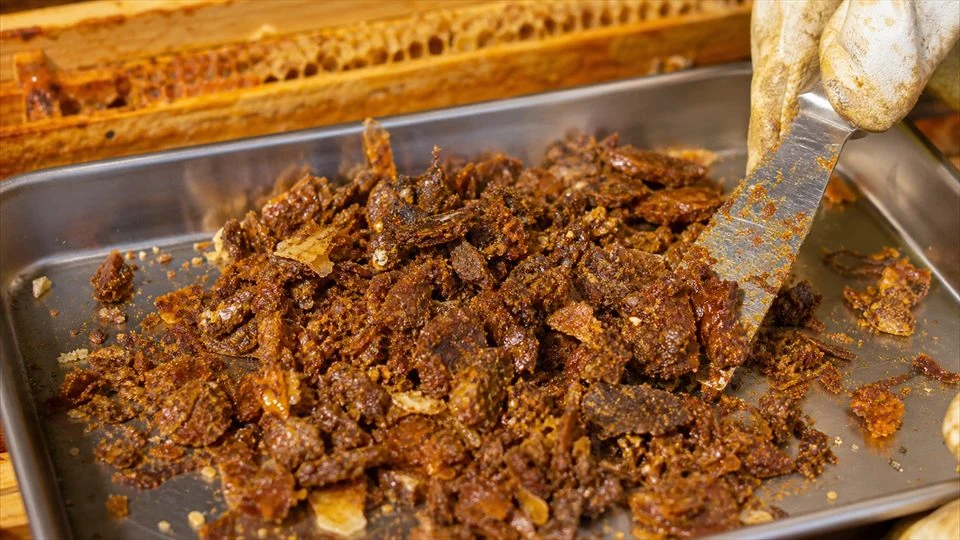
Bees collect resins from the buds of poplars, aspens and conifers, mix them with wax and their own secretions, and line the inside of the hive with the sticky mass. They plug fissures, varnish the walls and coat the corpses they cannot drag out. The result is an antimicrobial material that keeps a space holding 50,000 individuals at 35 °C sterile.
Its composition has a variability that is inconvenient for anyone wanting to sell it as though it were a drug: it depends entirely on the local flora. A European poplar propolis and a Pacific Macaranga propolis share little beyond the name. Reviews of the compound insist on that point before any other.1
What the evidence does support
Antibacterial activity is the most repeated and most solid finding: it appears consistently against gram-positive bacteria in laboratory assays, and is attributed above all to flavonoids and phenolic acids.2 Broad reviews add antioxidant, antifungal and anti-inflammatory activity in experimental models.1
Where the chain breaks
Almost all of that is in vitro. That an extract inhibits a culture in a dish does not let you deduce what happens in a throat, with a diluted dose, a contact time of seconds and a metabolism in between. Clinical trials exist, but they are small, heterogeneous and use propolis of differing composition, which means their results cannot simply be added together.1
Put bluntly: propolis does not replace an antibiotic, does not treat a diagnosed infection and should not delay a consultation.
On the skin
Dermatology is where its use is best described. The review of bee products in skin care records their use in formulations for irritated skin and in wound healing, alongside wax and honey.3 It is also the route by which most people discover they are allergic to it.
The other side, which almost nobody mentions
Propolis is a well documented contact sensitiser. Hausen’s work identified the compounds responsible and their kinship with poplar buds and balsam of Peru, which explains the cross reactions.4 In a series of 1,255 children given patch tests, sensitisation to propolis appeared associated with sensitivity to balsam of Peru.5
And it does not stop at the skin: systemic contact dermatitis from ingestion has been described, that is, a generalised eruption after taking it orally in someone already sensitised.6 The patient information leaflet from the British Society for Cutaneous Allergy gives the usual test concentration and the everyday sources of exposure.7
How to choose one without fooling yourself
Declared botanical origin. If it does not say where the resin comes from, the composition is an unknown.
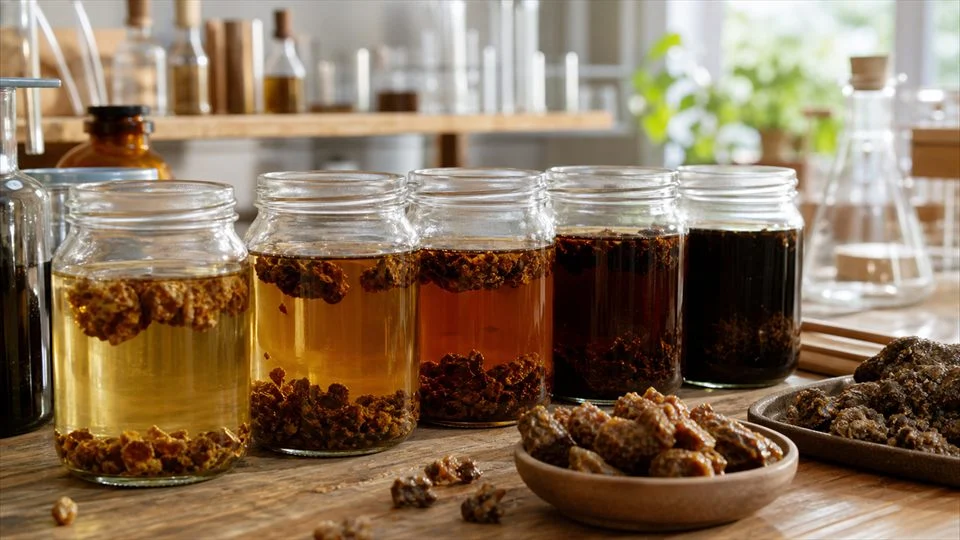
Real concentration, not colour. A dark extract is not necessarily richer; the colour depends on the solvent and the maceration time.
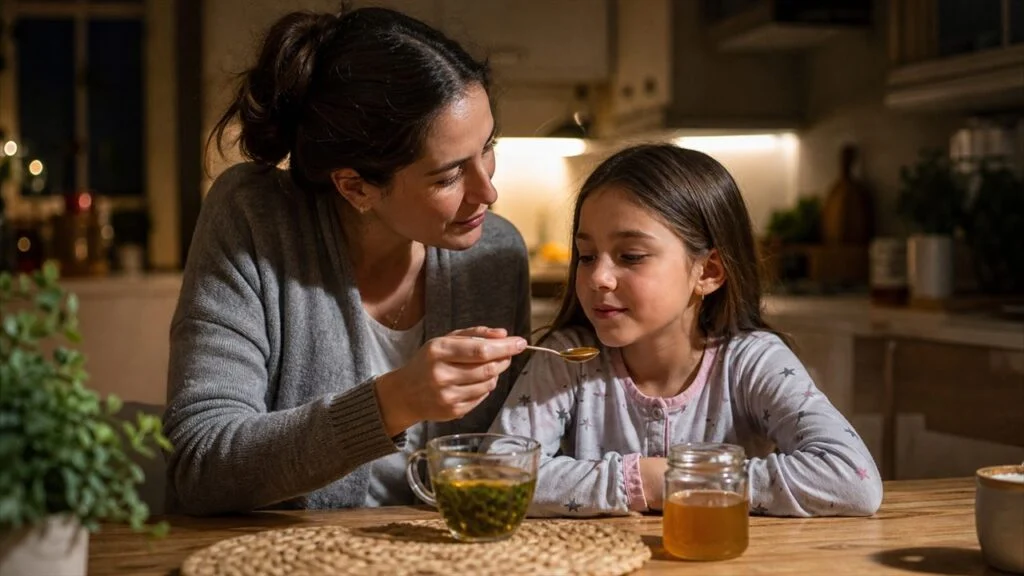
With or without alcohol depending on use. A glycerine base makes sense for oral use in children or while fasting; the hydroalcoholic one extracts flavonoids better.
Test on skin before the mouth. A small application on the forearm over 48 hours reveals a sensitisation before it shows up by the oral route.
If you have a known allergy to balsam of Peru, to poplar resins or to bee venom, ask first. And at any reaction, stop taking it: the details are on our allergies and precautions page.
References
- Zullkiflee, N., Taha, H., & Usman, A. (2022). Propolis: its role and efficacy in human health and diseases. Molecules, 27(18), 6120. https://pubmed.ncbi.nlm.nih.gov/36144852/
- Przybyłek, I., & Karpiński, T. M. (2019). Antibacterial properties of propolis. Molecules, 24(11), 2047. https://pubmed.ncbi.nlm.nih.gov/31146392/
- Kurek-Górecka, A., Górecki, M., Rzepecka-Stojko, A., Balwierz, R., & Stojko, J. (2020). Bee products in dermatology and skin care. Molecules, 25(3), 556. https://pubmed.ncbi.nlm.nih.gov/32012913/
- Hausen, B. M., Evers, P., Stüwe, H. T., König, W. A., & Wollenweber, E. (1992). Propolis allergy (IV). Studies with further sensitizers from propolis and constituents common to propolis, poplar buds and balsam of Peru. Contact Dermatitis, 26(1), 34-44. https://pubmed.ncbi.nlm.nih.gov/1600736/
- Giusti, F., Miglietta, R., Pepe, P., & Seidenari, S. (2004). Sensitization to propolis in 1255 children undergoing patch testing. Contact Dermatitis, 51(5-6), 255-258. https://pubmed.ncbi.nlm.nih.gov/15606649/
- Cho, E., Lee, J. D., & Cho, S. H. (2011). Systemic contact dermatitis from propolis ingestion. Annals of Dermatology, 23(1), 85-88. https://pmc.ncbi.nlm.nih.gov/articles/PMC3120007/
- British Society for Cutaneous Allergy (s. f.). Propolis [hoja informativa para pacientes]. BSCA. Consultado el 19 de julio de 2026. https://cutaneousallergy.org/pils/propolis/