Pollen is the only hive product that is, literally, bee food. It is not an extract or a derivative: it is grains pressed into pellets by the hind legs of thousands of workers. It is also the one that has caused the most serious reactions, and the one explained worst in the shop.
What a pollen pellet is
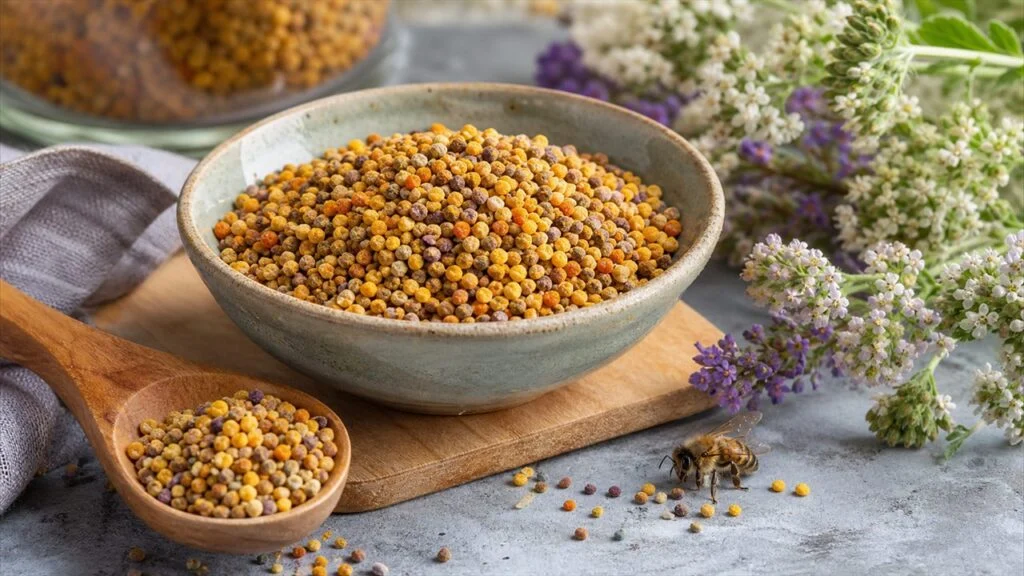
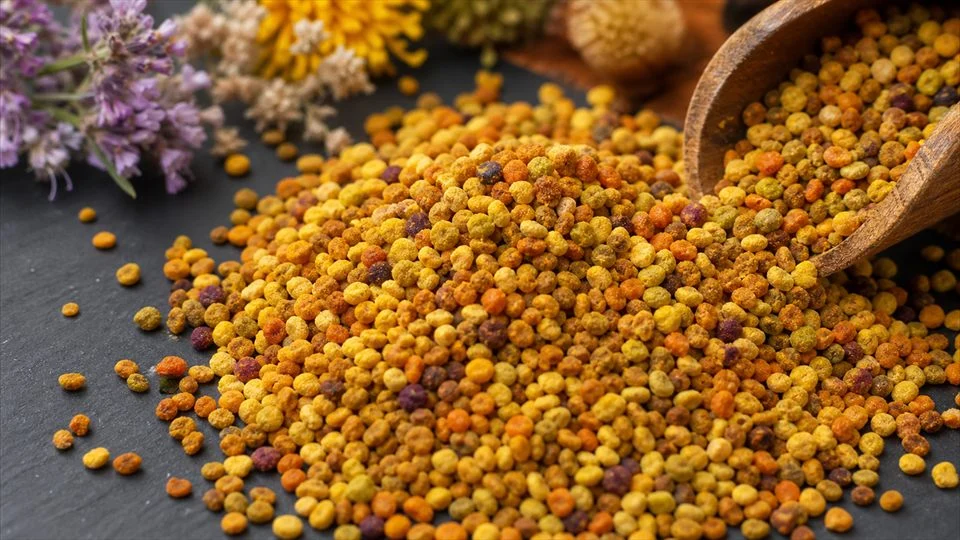
The bee gathers pollen grains, moistens them with nectar and her own secretions and packs them into the baskets on her legs. Each pellet is a mixture of the flowers that bee visited on that trip: which is why a pollen does not have a colour, it has a palette. The more varied the palette, the more diverse the bloom it came from.
Nutritionally it is the most complete bee product: proteins with essential amino acids, lipids, vitamins, minerals and a notable phenolic fraction. Composition reviews agree on that description and on its enormous variability according to botanical origin.12
What it genuinely provides
The phenolic profile is responsible for much of the scientific interest, and has been linked directly to its antioxidant potential.3 Reviews treating it as a functional food describe antioxidant and anti-inflammatory activity in experimental models, as well as its value as a nutritional ingredient in its own right.14
It is worth being precise with the language: a nutrient dense food, yes; a medicine, no. The distance between an activity measured in the laboratory and a demonstrated clinical benefit is still not covered by large trials in people.
How to take it without wasting it
Start with a little. Half a teaspoon for the first few days. Not for fine dosing, but to detect an intolerance before you have taken a large amount.
Cold. Yoghurt, fruit, warm milk. If you put it into something hot you lose part of what you paid for.
Hydrated rather than dry. Leaving it a few minutes in liquid softens the wall of the grain and improves access to the contents.
In the fridge and in the dark. Raw pollen is sensitive to humidity and light; at room temperature it cakes and goes rancid.
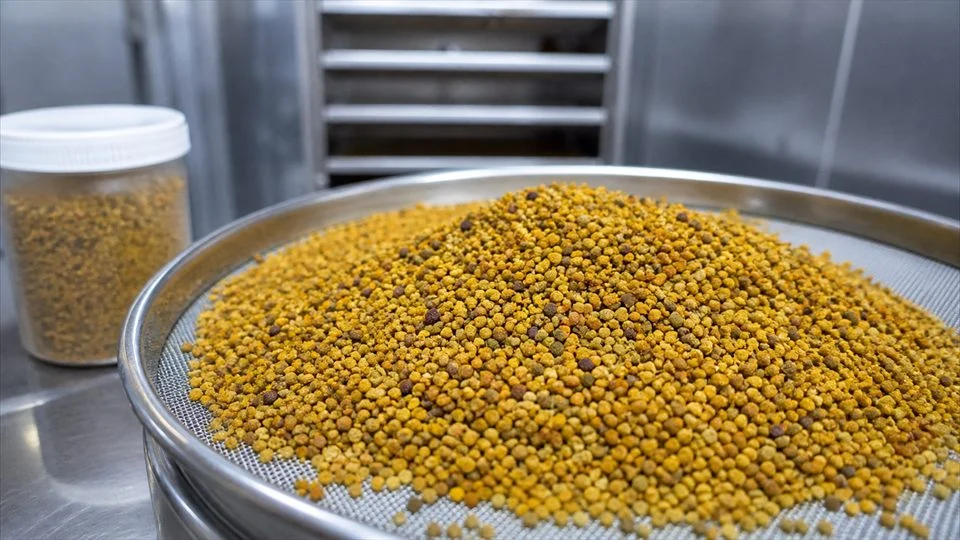
If it is sold to you heat dried, it is more stable and cheaper, but it is no longer raw. Neither of the two is a deception as long as it is written on the label.
The warning that has to be given
Of everything we sell, pollen has the most published cases of anaphylaxis. A review with a clinical case gathered the described cases and pointed to cross reactivity with pollens of the Compositae family (mugwort, ragweed, sunflower) as the most frequent mechanism.5
A case published in CMAJ is explicit about something we find decisive: consumers do not know the risk exists, because the product is perceived as harmless by virtue of being natural.6 And there is a still less obvious route: a paediatric case of anaphylaxis aggravated by exercise after ingesting pollen, in which the food alone was not enough to trigger the reaction.7
Who should avoid it or ask first
People with pollen allergies, especially to composites. People with asthma or atopy. Children under one year old. And anyone who has had a previous reaction to a hive product. We set it out in allergies and precautions.
References
- El Ghouizi, A., Bakour, M., Laaroussi, H., Ousaaid, D., El Menyiy, N., & Hano, C. (2023). Bee pollen as functional food: insights into its composition and therapeutic properties. Antioxidants, 12(3), 557. https://pubmed.ncbi.nlm.nih.gov/36978805/
- Komosinska-Vassev, K., Olczyk, P., Kaźmierczak, J., Mencner, L., & Olczyk, K. (2015). Bee pollen: chemical composition and therapeutic application. Evidence-Based Complementary and Alternative Medicine, 2015, 297425. https://pubmed.ncbi.nlm.nih.gov/25861358/
- Kostić, A. Ž., Milinčić, D. D., Barać, M. B., Ali Shariati, M., Tešić, Ž. L., & Pešić, M. B. (2020). The application of pollen as a functional food and feed ingredient: the present and perspectives. Biomolecules, 10(1), 84. https://pubmed.ncbi.nlm.nih.gov/31948037/
- Baky, M. H., Abouelela, M. B., Wang, K., & Farag, M. A. (2023). Bee pollen and bread as a super-food: a comparative review of their metabolome composition and quality assessment. Molecules, 28(2), 715. https://pubmed.ncbi.nlm.nih.gov/36677772/
- Choi, J. H., Jang, Y. S., Oh, J. W., Kim, C. H., & Hyun, I. G. (2015). Bee pollen-induced anaphylaxis: a case report and literature review. Allergy, Asthma & Immunology Research, 7(5), 513-517. https://pubmed.ncbi.nlm.nih.gov/25749764/
- Jagdis, A., & Sussman, G. (2012). Anaphylaxis from bee pollen supplement. Canadian Medical Association Journal, 184(10), 1167-1169. doi:10.1503/cmaj.112181. https://www.cmaj.ca/content/184/10/1167
- Leang, Z. X., Thalayasingam, M., & O’Sullivan, M. (2022). A paediatric case of exercise-augmented anaphylaxis following bee pollen ingestion in Western Australia. Asia Pacific Allergy, 12(3), e23. https://pmc.ncbi.nlm.nih.gov/articles/PMC9353203/